Katahdin Lambing Part 6: NSIP, Growth, and Selection
A spring-born ewe lamb is a retention decision waiting to happen. The decision is not made on the day you sort her. It is made by the data you captured on her - and on her dam, her sire, and her contemporary group - across the first twelve months of her life. If the weights were not taken inside the right windows, the decision is guesswork.
Part 1 covered preparation. Part 2 covered the labor and the first 72 hours. Part 3 covered rejection and bottle lambs. This article covers the structured measurement program that turns a year of observation into selection decisions: NSIP weighing milestones, ultrasound scanning, the LAMBPLAN cycle, the KHSI-NSIP interaction, growth and nutrition through the yearling, and the ewe-lamb and ram-lamb selection-stage exams that determine who joins the breeding flock.
The NSIP Framework
The National Sheep Improvement Program is the U.S. genetic-evaluation infrastructure for sheep. Enrolled flocks submit weights, parentage, and structured measurements to LAMBPLAN, which returns Estimated Breeding Values (EBVs) per animal across growth, maternal, and parasite-resistance traits. The standard data-management software is Pedigree Wizard (also called PedigreeMaster), distributed by LAMBPLAN in Australia. Pedigree Wizard runs only on 32-bit Windows. On a 64-bit machine it requires a virtual machine, and the install file is available on the LAMBPLAN server only for approximately two months after registration. Alternative paid and freeware tools are documented; contact the Katahdin NSIP coordinator for current options.
Katahdins were the first U.S. breed to launch genomic-enhanced EBVs. In 2020 Katahdin Hair Sheep International (KHSI) won an NSIIC grant to launch the first NSIP genomics project in the U.S., drawing on an existing reference population from Dr. Joan Burke's parasite-resistance study at the USDA Booneville research station. gEBVs raise the value of submitting DNA on retained breeding stock; the genotype enriches the prediction beyond what pedigree-and-phenotype alone produces.
Submission cadence is twice monthly, year-round. Producers submit after birth weights, after 60-day weights, and again after post-weaning weights - submissions can be partial and rolling rather than batched annually. The annual NSIP flock fee covers any number of submissions in the period. The per-animal data fee is triggered only at the first post-90-day submission, and up to 25 percent of the lamb crop may be flagged "cull" or "commercial" at that point with no fee assessed. Those flagged animals will not get EBVs computed, which lets a small flock submit early-life data on every lamb but pay only for the retained genetic-evaluation animals.
Weighing Milestones Through the Yearling
The NSIP weighing milestones for Katahdins are five distinct events: birth, weaning, post-weaning, late post-weaning, and yearling. Each has its own window and its own role in the EBV calculation. Missing the window does not just lose a data point; it blunts the accuracy of every EBV downstream that depends on the missing weight.
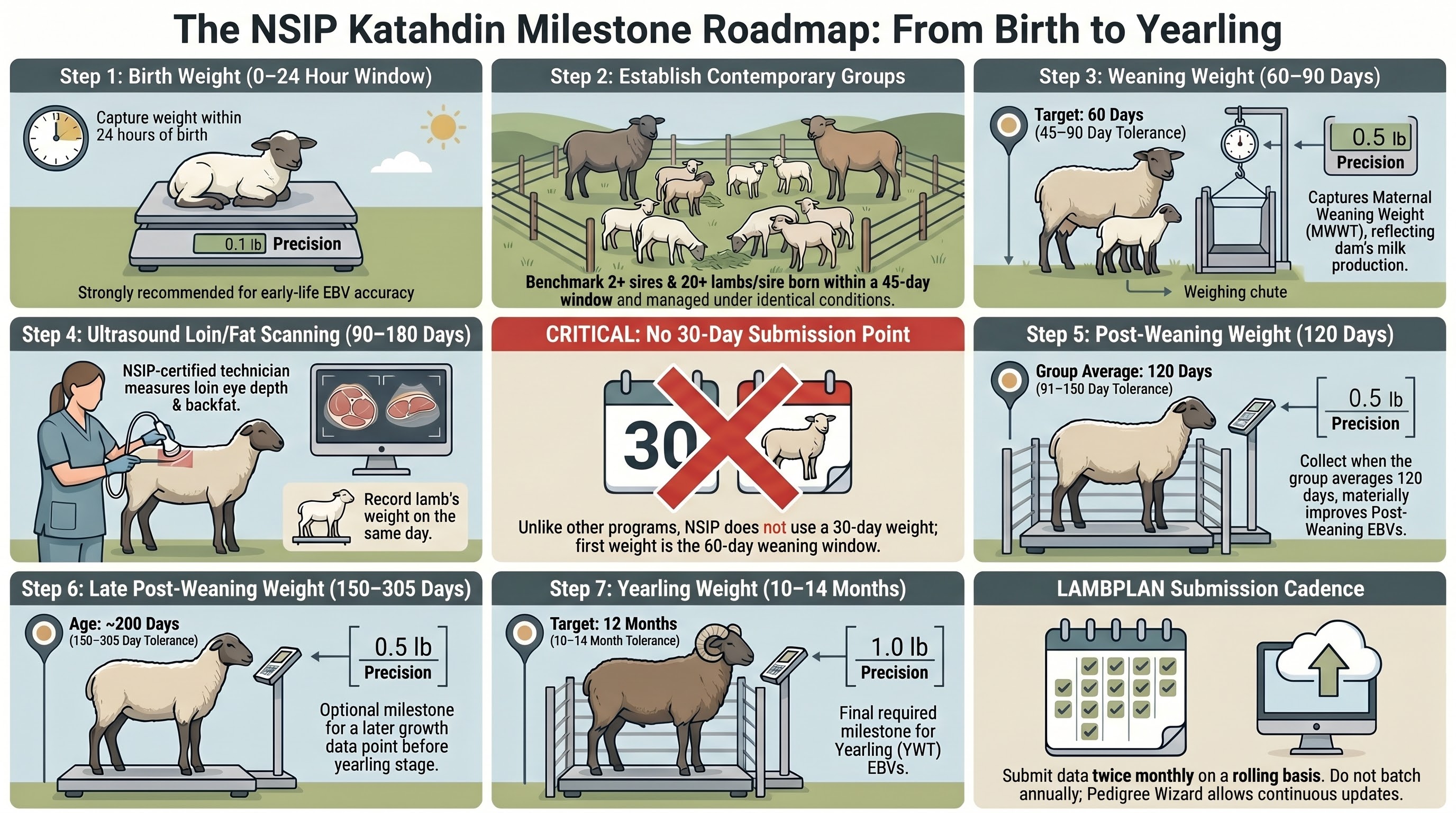
| Milestone | Target age | Tolerance window | Required precision | Status |
|---|---|---|---|---|
| Birth weight | Within 24 hours | First 24 hours | 0.1 lb where the scale supports it | NSIP-optional but strongly recommended |
| Weaning weight (WWT) | ~60 days | 45-89 days | 0.5 lb | Required |
| Post-weaning weight (PWWT) | ~120 days | 91-150 days | 0.5 lb | Required for accurate PWWT EBVs |
| Late post-weaning weight | 150-305 days | 150-305 days | 0.5 lb | Optional |
| Yearling weight (YWT) | 10-14 months | 10-14 months | 1 lb | Required for YWT EBVs |
There is no 30-day submission point. Any earlier reference to a 30-day NSIP weigh-in is a misreading of the spec. The submission spec moves from birth directly to the 45-89 day weaning window.
Birth weight is captured in the first 24 hours along with sire ID, dam ID, sex, birth type (single, twin, triplet, or larger), and rear type. Birth type and rear type often differ - a ewe lambing triplets but raising two records "3" for birth and "2" for rear. The Eastern Alliance for Production Katahdins is direct on the optional-but-strongly-recommended framing: birth weight improves EBV accuracy, and the 24-hour capture window is a planning constraint, not a suggestion.
Weaning weight is taken on all lambs in a contemporary group on a single day when the group average is approximately 60 days and individuals are between 45 and 89 days. LAMBPLAN auto-adjusts each weight for the lamb's actual age. The 60-day timing is chosen because ewes are still producing meaningful milk at that point, which is what enables the derivation of Maternal Weaning Weight (MWWT) - the indirect milk-and-mothering metric described below.
Early post-weaning weight is collected on a single day when the group averages approximately 120 days and individuals are 91 to 150 days old. The 120-day weight materially improves PWWT-EBV accuracy over computing PWWT from the 60-day weight alone. For a small flock making retention decisions at six to nine months, this is the weight that closes the loop between weaning data and selection.
Late post-weaning weight is optional and can be taken when lambs are 150 to 305 days. Yearling weight is required for YWT EBVs and is captured between 10 and 14 months of age. Hogget weights at 13 to 18 months and adult weights are accepted by LAMBPLAN but optional and do not generate distinct EBVs.
Ultrasound Loin Scanning and Scrotal Circumference
NSIP ultrasound carcass scanning collects loin eye area (LEA), loin eye depth (LED), and 12th-rib backfat. The Katahdin window is 90 to 180 days of age. Scans must be performed by an NSIP-certified ultrasound technician - certification is maintained through periodic accuracy and repeatability testing against live lambs. The lamb's weight must be recorded the same day as the scan. Scanning is optional in NSIP but adds material value to the carcass-trait EBVs and is the only structured way to evaluate growth-vs-finish balance before the lamb reaches market weight.
Scrotal circumference is a Katahdin-specific NSIP optional measurement collected between 150 and 240 days (roughly 5 to 8 months). Scrotal circumference is moderately heritable and correlates with semen production, age at puberty in female offspring, and overall ram fertility. The breeding-soundness threshold is described later in this article; for NSIP purposes, the measurement is taken in the 5-to-8-month window and submitted with the post-weaning data block.
Maternal Traits and the MWWT Mechanism
NSIP does not currently calculate EBVs from lambing-ease scores or mothering-ability scores. The maternal genetic component is captured indirectly through Maternal Weaning Weight (MWWT), derived from the lamb's 60-day weaning weight as a proxy for the dam's milk production and mothering. Producers are still encouraged to record lambing ease and mothering scores in the flock book - the records have value for within-flock culling decisions even though they are not fed into the LAMBPLAN evaluation. The practical implication: a heavy 60-day weight on a twin-born lamb tells you something about both the lamb's growth genetics and the dam's mothering ability, and MWWT is how the system separates those two contributions.
Contemporary Groups - The Structural Requirement
NSIP recommends contemporary groups containing at least two sires, with 20 lambs per sire, born within a 45-day window and managed as a single group. Without that structure, EBVs are within-flock only and cannot be benchmarked across the breed. Artificially-reared lambs and wethers should each receive their own management code so they are not compared against dam-raised intact lambs.
For a small flock, the across-flock comparability problem is real. Large flocks (>=150 ewes) with good contemporary structure can produce useful within-flock EBVs in a few seasons. A 20-ewe operation needs either more years of submission or stronger genetic links to other NSIP flocks. The most direct way to build linkage is to use proven sires (or sons of proven sires) from other NSIP participants. Movement of ewes between NSIP flocks has only modest effect on linkage strength. Buying or leasing the right ram is the lever.
KHSI Registration and the Scrapie/Parentage Constraints
KHSI registration interacts with NSIP at three points where small-flock operations get caught out.
Codon 171 scrapie genotype. All entries to KHSI events must be RR or QR at codon 171, with lab results provided at check-in. The QQ genotype is excluded from event entry. This is a registry rule, not a regulatory rule, but it shapes which lambs can be sold as registered breeding stock and which cannot. Genotyping is a one-time test per animal; if the lamb is destined for retention or registered sale, the test belongs in the post-weaning workflow.
Multi-sire parentage testing. Multiple-sire breeding groups submitted to NSIP require DNA parentage testing on all lambs. Relying on ram-marking-crayon marks alone yields sire mismatching that cascades into inaccurate EBVs across every progeny line. For a small flock running a single mature ram, this constraint does not bind. For any flock running two or more rams in a single breeding group, parentage testing on every lamb is the cost of NSIP submission.
16-digit LAMBPLAN ID immutability. Each NSIP animal gets a 16-digit ID encoding breed, flock, birth year, and unique animal ID. Once assigned, the ID must never be altered. Pedigree Wizard records of dead or sold animals must never be deleted - set the "Status" field instead. The discipline implication is record-keeping at the animal level: tag at birth with the flock-internal ID, then map to the assigned 16-digit ID at first submission, and treat both as permanent.
KHSI also requires membership dues to be current to register sheep, effective May 1, 2020. Lapsed dues block the entire registration pipeline.
Creep Feed and Early Rumen Development
Lambs can be offered creep feed as early as 10 days of age, but meaningful intake does not begin until three to four weeks. Early access primarily exists to develop the rumen and habituate the lamb to dry feed, not to displace milk. Penn State Extension and the Maryland Small Ruminant Page converge on a starter creep at 18 to 20 percent crude protein, transitioning to 14 to 16 percent by weaning.
The standard early creep formulation is 80 to 85 percent ground or cracked corn plus 15 to 20 percent soybean meal, with free-choice high-quality alfalfa hay alongside. Two formulation rules deserve permanent placement in the feed shed:
- Calcium-to-phosphorus ratio must be 2:1 or higher to prevent urinary calculi in male lambs. Wether and ram-lamb groups are at elevated risk; Ca:P management is non-negotiable.
- Ammonium chloride at 0.5 percent of total diet provides additional calculi protection. Most commercial lamb creeps already include it; if you mix on-farm, add it.
Feed-efficiency target is 2 to 4 lb feed per 1 lb gain. Coccidiostats (Bovatec or Deccox) are commonly added to lamb creep - both are FDA-labeled for sheep. Amprolium is extra-label for sheep and carries thiamine-antagonism risk; default to the labeled options.
Weaning Age and the Cortisol Argument
Eastern Alliance for Production Katahdins recommends bottle lambs can be weaned off milk as early as 30 days if they weigh 30 lb or more and are eating adequate creep. Dam-raised lambs on milk and forage should ideally not be weaned until 90 to 100 days, when their rumen is fully functional. The published weaning categories are early (30-60 days), traditional (61-90 days), and late (greater than 90 days).
A 2023 Applied Animal Behaviour Science study (Jaborek et al.) compared progressive and abrupt weaning in lambs. Lambs progressively weaned over four weeks (16 hours per day separation by week 4) secreted less cortisol after social isolation at 90 days than lambs abruptly weaned at 61 days. Cortisol concentrations were also lower and body weights greater after progressive weaning from 39-45 days versus abrupt weaning at 45 days. For a small farm able to gate-separate ewes and lambs in a barn, progressive weaning is the better-supported welfare protocol. The cortisol research is generic-lamb literature; Katahdin-specific cortisol-and-weaning data is not published.
The 30/30 rule for bottle lambs (>=30 days, >=30 lb, eating creep reliably) is a hard floor. Below either threshold, weaning produces a setback that is harder to recover from than the additional milk cost.
Mid-Atlantic Forage Through the Year
The mid-Atlantic forage calendar has three modes that shape the post-weaning nutritional plan:
- Spring flush - cool-season grasses surge from late March through May. Energy and protein are abundant; weaned lambs grow quickly on pasture alone.
- Summer slump - endophyte-infected tall fescue dominates pastures across the transition zone, including Cumberland County, Virginia. Ergovaline is the principal alkaloid, and it causes reduced gain, poor conception, possible fescue foot in extremities, and reproductive losses in ewes. Mitigation comes from establishing summer annuals (sorghum-sudan, crabgrass, brassicas) for July-August grazing and shifting fescue grazing to spring, fall, and stockpiled winter use. Alkaloid concentrations decline up to 85 percent as winter progresses, which is why stockpiled fescue is safer than fresh summer fescue.
- Autumn flush - cool-season regrowth in September and October provides a second high-quality grazing window before frost.
For Epic Pastures-scale operations in the mid-Atlantic, the forage plan for weaned lambs running through their first winter is quality-tested hay (test before you feed, do not assume) plus modest grain supplementation, especially when forage quality is limited. Energy demand rises in cold weather to maintain body temperature. Water intake increases when sheep transition from pasture to dry hay diet. Keep tanks ice-free, near a barn door for ease of management, in sun and out of wind. Water above 40°F encourages adequate intake. Inadequate water intake on a hay diet produces impaction and reduces hay consumption, which compounds energy deficit.
Mineral Supplementation Post-Weaning
The selenium and copper questions from Part 1 escalate in the post-weaning period, when the lamb is on its own metabolism rather than the dam's reserves.
Selenium. Total diet for sheep should contain 0.10 to 0.30 ppm selenium with daily intake under 0.7 mg per head per day to avoid toxicity. The mid-Atlantic falls within the broad selenium-deficient zone. White muscle disease (nutritional muscular dystrophy) appears in lambs born to selenium-deficient ewes, and selenium is co-administered with vitamin E because deficiency presents identically. The Katahdin-specific caution is real: a peer-reviewed Canadian Veterinary Journal case report documents selenium toxicosis in a Katahdin flock from over-supplementation. Do not stack selenium sources. Mineral plus injectable plus drench plus bolus, applied without a liver panel as a baseline, can push the flock into toxicity. If the mineral program is comprehensive, additional selenium drenches are not warranted without testing.
Copper. Sheep require approximately 4 to 6 ppm copper in the dry-matter diet at minimum, with 8 to 11 ppm typical. Hair sheep generally tolerate more copper than wool sheep, and Katahdins specifically appear to need more than the wool-sheep baseline. Documented copper toxicity cases in Katahdins exist nonetheless; the wider tolerance is not unlimited. Molybdenum-copper antagonism complicates the picture: high molybdenum can induce copper deficiency and is sometimes used therapeutically against copper toxicity. Liver biopsy testing (approximately $55 at Michigan State University) is the only reliable way to know flock copper status. Per-flock liver biopsy is the practical workflow for any operation considering supplementation beyond the standard sheep mineral.
The single rule for mineral programs: use a sheep-specific loose mineral, free-choice. Goat mineral, cattle mineral, and "all-stock" mineral are not substitutes. The copper levels differ across species and the wrong mineral over time creates the exact problem the program is supposed to prevent.
Growth Curve Targets
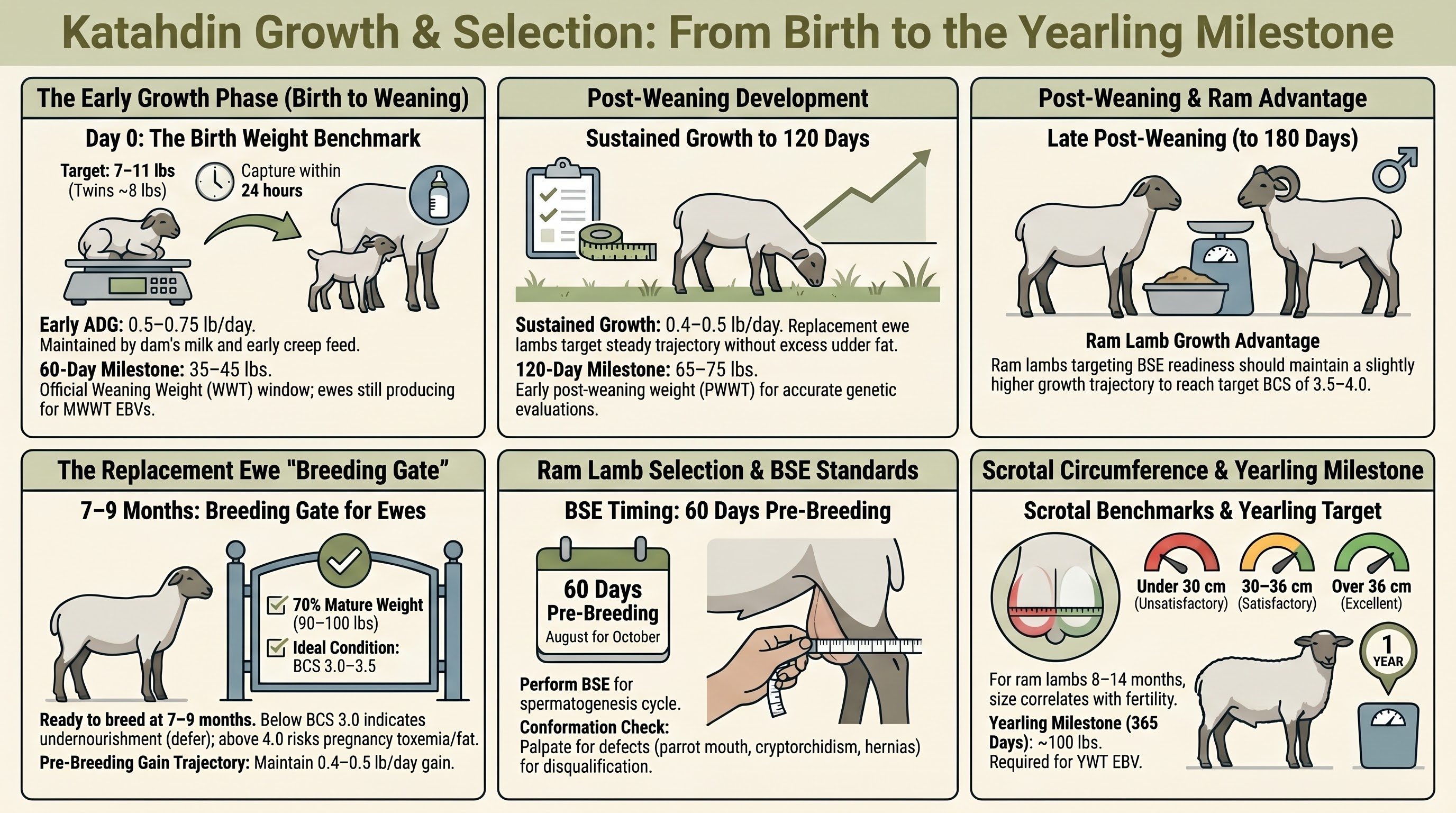
Katahdin breeders target the following weights at the indicated ages. The numbers are pasture-based; barn-finished lambs accelerate, and lambs short on milk or forage lag.
| Age | Target weight (Katahdin, pasture-based) |
|---|---|
| Birth | 7-11 lb (twins ~8 lb average) |
| 60 days (weaning) | 35-45 lb |
| 90 days | 50-60 lb |
| 120 days | 65-75 lb |
| 180 days (6 months) | 75-90 lb |
| 270 days (9 months) | ~80-95 lb |
| 365 days (yearling) | ~100 lb on grass |
Slaughter window for market lambs is six to eight months at 80 to 120 lb. Replacement ewe lambs need approximately two-thirds of mature size before first breeding - for a flock with 150 lb mature ewes, ewe lambs should hit 100 lb or more before exposure to a ram. A Katahdin-specific monthly average daily gain (ADG) curve is not published in the extension literature. Target weights at each milestone are the workable reference.
Replacement Ewe Lamb Selection
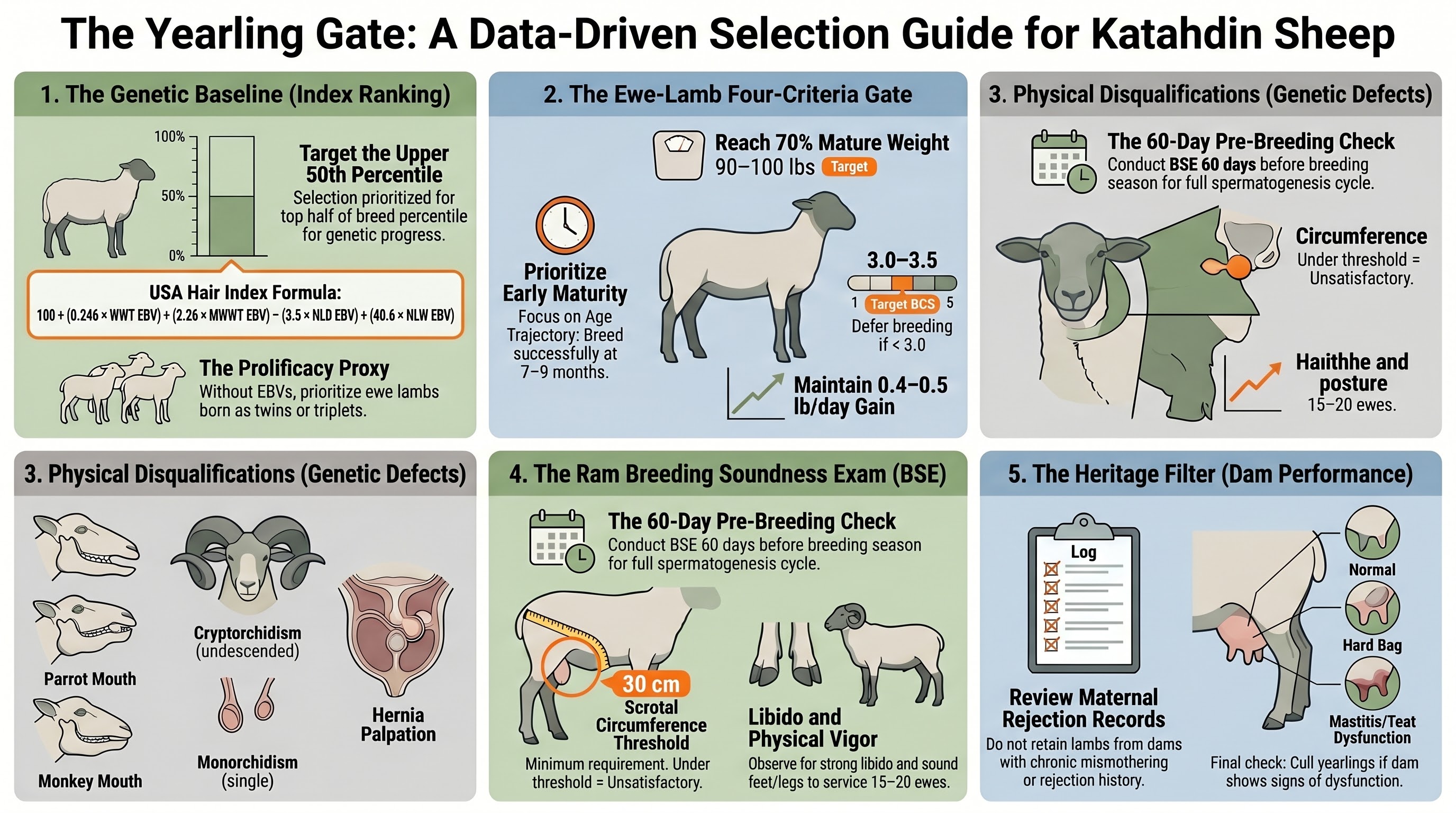
The ewe-lamb breeding gate is multi-source. Eastern Alliance for Production Katahdins, SDSU Extension, and Penn State Extension converge on a four-criteria gate:
- Weight. Approximately 70 percent of mature weight, which in Katahdins is 90 to 100 lb. SDSU widens this to 65 to 75 percent.
- Body Condition Score. 3.0 to 3.5. Below 3.0 indicates underdeveloped or undernourished - defer breeding to second fall.
- Pre-breeding rate of gain. 0.4 to 0.5 lb per day to ensure she continues growing through gestation rather than diverting growth to the pregnancy.
- Age and lifetime trajectory. Early-maturing ewe lambs that breed at 7-9 months tend to be more prolific over their lifetime. Ewe lambs not bred until 18 months risk fat deposition in the udder that suppresses future milk production - feed conservatively if delaying first breeding.
For a spring-born Katahdin ewe lamb on Epic Pastures-scale management, the decision point is whether she hits approximately 90 lb and BCS 3 by the October breeding window at six to eight months of age. If she does, she is a candidate. If she does not, the choice is to defer to the second fall (with the udder-fat caution above) or to market.
Out-of-season breeding is harder for fall-born ewe lambs. Eastern Alliance fall-lambing guidance is direct that getting fall-born ewe lambs to breed in the spring to lamb at 12 months old is more difficult, and producers compensate by feeding 2 lb or more concentrate plus good hay through winter to push BCS to 4 or higher at spring breeding. For a flock running on the standard spring-lambing cycle, this constraint does not bind. For any flock considering accelerated lambing, the seasonality of ewe-lamb response is the rate-limiting factor.
Ram Lamb Selection and the Breeding Soundness Exam
Ram lambs go through a separate selection-stage exam that includes physical conformation, body condition, palpation for genetic defects, and the Breeding Soundness Examination (BSE).
Body condition. Target BCS for breeding rams is 3.5 to 4.0. Eastern Alliance is explicit on the over-conditioning warning: fat rams tire easily, may lack the stamina needed to service ewes, and excess weight stresses feet and legs. Under-conditioning produces poor semen quality and weak libido.
Genetic defects that disqualify retention. The selection-stage exam at six months or later must palpate for the following. Each is a hard cull-from-breeding decision:
- Parrot mouth (overshot jaw) and monkey mouth (undershot jaw). Both are highly genetic, affect nutrition, and disqualify the animal from breeding. Mouth every retention candidate.
- Cryptorchidism and monorchidism. Partial or fully undescended testicles disqualify a ram from breeding because the condition impedes fertility and is heritable. Both testicles must palpate fully into the scrotum.
- Umbilical hernia and scrotal hernia. Both disqualify due to heritability and increased risk during pregnancy (umbilical) or fertility impairment (scrotal). Hernia palpation belongs in the exam alongside mouthing and testicle palpation.
BSE timing. The BSE should occur at least 60 days before the intended breeding date because spermatogenesis takes approximately 60 days. The window allows time for treatment, replacement procurement, or self-correction. For an October breeding cycle, the BSE belongs in August on any retained ram lamb who will be 7 months or older by then.
Scrotal circumference thresholds. The Society for Theriogenology-aligned classifications from Merck Veterinary Manual for ram lambs 8 to 14 months are clear:
| Scrotal circumference | Classification |
|---|---|
| Less than 30 cm | Unsatisfactory |
| 30-36 cm | Questionable |
| Greater than 36 cm | Satisfactory |
Sperm production correlates positively with testicular circumference. Measurement requires pushing both testes fully into the scrotum and measuring at the widest point. Ram lambs falling in "questionable" should be re-measured 30 days later before a final decision.
Sperm motility and morphology. Merck/SFT-aligned grading: progressive sperm motility - less than 10 percent unsatisfactory, 10 to 30 percent questionable, 31 to 70 percent satisfactory, greater than 70 percent exceptional. Normal morphology - less than 30 percent, 30 to 50 percent, 51 to 80 percent, greater than 80 percent across the same scale.
Libido caveat. Libido is not routinely tested during BSE. Producers must rely on observation when the ram is exposed to ewes. A BSE-passing ram with low libido is not a breeding ram in practice. Watch the first week of exposure and replace if marking is poor.
The first-breeding ram-to-ewe ratio is 1:25 to 1:35 (SDSU Extension). Most extension sources tighten this for ram lambs (yearling rams in their first breeding season) to 1:15 or 1:20 because of lower stamina and inexperience. For a 20-ewe flock, a single mature ram is sufficient; a yearling ram doing his first season should not be paired with all 20 ewes simultaneously. Split-mating or pairing with a follow-up ram is the safer protocol.
Hoof Care Through the First Year
The Mississippi State Extension baseline husbandry cadence is checking hooves every four to six weeks, with trimming as needed and 15 to 18 percent zinc sulfate solution baths as preventive care. That is the default to compare any specific management against.
Katahdins on pasture trim less often than wool breeds. KHSI-aligned sources state Katahdin hoof-trimming need is climate- and environment-driven rather than breed-elevated, and that on good pasture Katahdins seldom require trimming compared to barn-housed or wool breeds. For a continuously-grazed flock, the four-to-six-week baseline relaxes to inspection-driven trims, with the qualifier that wet weather softens hooves and accelerates growth.
The practical cadence:
- Default windows. Inspection-driven on Katahdin pasture; check at every other gathering and trim only animals that need it.
- Wet-spring window (March-May) and wet-fall window (October-November). Daily lameness inspection, not the once-a-month default. University of Maine and Virginia Cooperative Extension flag persistent wet conditions as the operative driver: moisture softens horny tissue and makes the foot vulnerable to irritation, injury, and infection.
Foot rot versus foot scald. True virulent foot rot requires synergistic infection by Dichelobacter nodosus and Fusobacterium necrophorum. Ovine interdigital dermatitis ("scald") is caused by F. necrophorum (often with Actinomyces pyogenes) without virulent D. nodosus. The distinction matters for treatment escalation. Scald typically resolves when conditions dry. True foot rot requires aggressive footbath, trimming, potential antibiotic therapy, and may persist between wet seasons.
Zinc sulfate footbath. Foot baths and soaks with 10 percent zinc sulfate (8 lb zinc sulfate to 10 gallons of water) usually result in improved healing of either foot rot or foot scald. Recommended use is a 5-to-10-minute soak, then standing on a dry surface for 30 to 60 minutes before returning to pasture.
Entropion Follow-Up and Heritability
Part 2 covered entropion intervention at birth. Two follow-ups belong in the post-natal selection workflow.
Removal point. Merck Veterinary Manual states that primary entropion surgery should not be performed in lambs because it produces cicatricial ectropion as the lamb grows. Standard treatment is temporary eyelid-tacking sutures or surgical staples left in place for two to three weeks. Recheck at the 2-to-3-week point to confirm resolution before staples or sutures fall out.
Retention rule. Entropion has a heritable component. A 2024 Wiley study comparing Romane and Ile de France breeds found re-treatment was needed more often in Ile de France than Romane, with Romane showing higher spontaneous recovery. Katahdin-specific entropion heritability data is not published, but the breed-comparative literature is sufficient to set the rule: a lamb treated for entropion at birth should be tracked for life. Do not retain affected ewe lambs as breeding stock. Repeat presentations count against keeping the animal as a replacement and against keeping its dam or sire as breeders.
Dam Culling From the Rejection Record
Part 3 logged rejection events as flock-level data. The post-natal selection workflow is where that record turns into cull decisions.
OSU Small Ruminant Team's Cull Ewe Checklist and University of Wisconsin Extension converge on three culling categories that connect directly to the rejection record and to the udder exam at weaning:
- Mothering disposition. Mothering ability is heritable. Ewes that reject or harm lambs should be culled for disposition. A dam logged in the rejection record across two seasons is a removal candidate at the post-weaning sort.
- Reproductive failure. Ewes that fail to raise a lamb should be culled - no ewe is profitable without producing a lamb. One missed season is not automatic; two consecutive seasons is.
- Udder and teat dysfunction. Ewes with no milk, abnormal or misshapen teats, hard udder, or otherwise non-functioning mammary system should be culled. Hard bag affecting both halves may indicate ovine progressive pneumonia (OPP) or chronic mastitis - both lead to lamb starvation. Udder palpation and visual inspection at weaning is the trigger for adding a ewe to the fall cull list, complementary to the rejection record.
For a 20-ewe flock, the cull list is rarely long, and the discipline of building it from records rather than memory pays off across multiple seasons.
The USA Hair Index
Eastern Alliance for Production Katahdins Fact Sheet #5 defines the USA Hair Index (also called the Katahdin Index or Ewe Productivity Index) as:
USA Hair Index = 100 + (0.246 * WWT EBV) + (2.26 * MWWT EBV) - (3.5 * NLB EBV) + (40.6 * NLW EBV)
Where WWT is weaning weight, MWWT is maternal weaning weight, NLB is number of lambs born, and NLW is number of lambs weaned. The index targets pounds of lamb weaned per ewe lambing - which is the production metric that pays the operation.
For replacement-ewe selection, the USA Hair Index is the single number to rank candidates after they pass the health and conformation gates. Ewe lambs in the upper half of the breed percentile report are retention candidates. The index does not replace the physical exam; it sequences the candidates that have already cleared the exam.
Two redundancy gates apply for first-cohort flocks where NSIP EBVs are not yet available on the lambs themselves:
- Twin or triplet birth as a proxy for prolificacy. KHSI guidance: without EBVs, most producers select for multiple births by retaining only twin- or triplet-born ewe lambs. Once NSIP EBVs are available the rule is superseded by lifetime NLB and NLW data on dam, sire, and relatives.
- Dam performance over multiple seasons. A ewe lamb whose dam has weaned twins for three consecutive seasons is a stronger candidate than a ewe lamb whose dam has weaned a single each year, regardless of birth type.
Capture 120-day weights on every retention candidate so PWWT EBVs are available when the retention decision finalizes at six to nine months. Relying on weaning-only EBVs blunts the accuracy of every downstream selection call.
First-Winter Feeding for Retained Lambs
Retained ewe lambs and ram lambs entering their first winter need a feeding plan that matches their growth trajectory to the limits of available forage. The mid-Atlantic plan:
- Forage base. Quality-tested hay, free-choice. Test the hay before you feed it; assumptions about hay quality have been wrong often enough that the test pays for itself.
- Energy supplementation. Modest grain - 0.5 to 1 lb per head per day for retained ewe lambs targeting BCS 3.0-3.5 by spring. More for ram lambs targeting BCS 3.5-4.0.
- Mineral. Sheep-specific loose mineral, free-choice, year-round. The selenium and copper guidance from earlier in this article applies through the winter.
- Water. Above 40°F, ice-free, sheltered from wind, accessible from the barn door. Adequate water intake on a hay diet is the bottleneck on hay consumption and therefore on energy intake.
Cold-weather energy demand rises measurably below 40°F. Plan for higher hay consumption on the coldest weeks and resist the temptation to manage fat ewe lambs into thin condition over the winter - under-conditioning at spring breeding is harder to recover from than the cost of additional hay.
A Pause Point Rather Than an Ending
Twelve months from a 7-pound newborn to a 100-pound yearling is the structural arc of Katahdin sheep production at the small-flock scale. NSIP is the measurement system that turns the arc into selection decisions. KHSI is the registry that makes the selection decisions tradeable as registered breeding stock. The growth-curve targets, the mineral program, and the hoof-care cadence are the husbandry that protects the arc from going off-trajectory.
The selection-stage exam at six to nine months is the single moment where a year of records becomes a retention decision. Mouth the candidate, palpate the testes (or run the udder check on the ewe lamb), measure scrotal circumference for retained rams, run the BSE 60 days before breeding, and check the USA Hair Index on every retention-eligible ewe lamb. The decisions get sharper every season the record-keeping stays disciplined.
Year two is its own management problem. Ewe-lamb pregnancies running into yearling lactation, finishing protocols on the market lambs that did not make the retention cut, BSE on second-season rams, the long arc of within-flock-EBV accuracy as more contemporary groups accumulate. Those are problems for another season.
Series navigation: Part 1: Preparation and Supplies - Part 2: Delivery and Complications - Part 3: Rejection and Bottle Lamb Care - Part 4: First-Weeks Procedures - Part 5: First-Year Health - Part 6 (this post)
Download the full NSIP and selection slide deck: Katahdin NSIP, Growth, and Selection (PDF)
This article synthesizes research from Katahdin Hair Sheep International, the National Sheep Improvement Program, the Eastern Alliance for Production Katahdins, university extension services (Penn State, Mississippi State, University of Maryland, Virginia Tech, SDSU, Purdue, Ohio State, University of Wisconsin, University of Maine, Cornell), the Merck Veterinary Manual, the Society for Theriogenology, peer-reviewed sources (Applied Animal Behaviour Science, Wiley Online, Canadian Veterinary Journal/PMC), and Baalands. It is intended as educational reference - always consult your veterinarian for medical decisions specific to your flock.