Katahdin Lambing Part 5: First-Year Health
The first year of a Katahdin lamb's life is decided by two protocols: a vaccine schedule that turns on the dam's history, and a parasite plan that scores individual lambs instead of the whole flock. Get those two right and most other first-year health problems are either prevented outright or caught early enough to fix. Get them wrong and the cost shows up at weaning weights, in EBVs, and in the genetics that move into your replacement pen.
Part 1 covered the pre-lambing preparation that determines whether the season has a chance. Part 2 covered labor and the first 72 hours. Part 3 covered rejection, grafting, and bottle-lamb conversion. This article picks up at the end of the lambing jug and runs through the first 365 days. The audience is a small Katahdin operation in the eastern United States - Cumberland County, Virginia in my case - running 20 ewes on improved pasture with limited barn confinement. The protocols in this article are calibrated to that scale and that climate. They are not the same protocols you would run in a confined feedlot or on the Caribbean rim where the parasite ecology shifts.
The structure follows the actual decision sequence: vaccinate, monitor parasites, prevent coccidiosis, manage pasture, and then prepare the retained ewe lambs for their first breeding season. Each section names primary sources. Internal flock numbers and farm specifics are noted where they affect a decision; the protocols themselves apply to any small Katahdin operation east of the Mississippi.
The First-Year Calendar at a Glance
A Katahdin lamb crosses several health-management gates between birth and 365 days. The default sequence on a well-managed pasture is short:
| Age | Action | Driver |
|---|---|---|
| 0 to 24 hours | Colostrum, navel dip, optional birth weight for NSIP | Passive transfer; NSIP optional birth weight |
| 1 to 14 days | Castration banding under AVMA stratified architecture (ram lambs not retained as breeding stock) | AVMA welfare guidance |
| 4 to 6 weeks | First FAMACHA score; coccidiosis prevention if pasture pressure is high | Eimeria peak window starts |
| 6 to 8 weeks | First CDT primary (lambs of vaccinated dams); weaning at ~60 days for NSIP | Michigan State University Extension and Mississippi State Extension |
| 10 to 12 weeks | CDT booster 3 to 4 weeks after primary | Michigan State University Extension |
| 1 to 2 weeks before banding | Pre-banding CDT booster for tetanus protection | OSU Small Ruminant Team |
| 4 to 8 weeks | Coccidiosis peak risk window | Merck Veterinary Manual |
| Throughout grazing season | FAMACHA every 14 days at high parasite pressure; less often at low pressure | ACSRPC Five Point Check |
| 7 to 9 months | Pre-breeding annual CDT booster for retained ewe lambs | EAPK breeding preparations |
| 12 months | Yearling weight for NSIP; full annual booster cycle established | NSIP weighing milestones |
The rest of this article is the detail behind each row.
The CDT Vaccine Decision Tree
CDT - Clostridium perfringens types C and D plus Clostridium tetani - is the one vaccine every sheep operation in the eastern US runs. It is cheap, the disease consequences are catastrophic, and the timing is well-studied. What surprises new shepherds is that the lamb schedule forks on the dam's vaccination history.
Lambs from CDT-vaccinated dams
If the dam was correctly boostered 2 to 4 weeks before lambing, the colostrum carries protective titers that wane around 6 to 8 weeks. Vaccinating earlier wastes the dose because maternal antibody neutralizes the vaccine antigen.
The protocol from Mississippi State University Extension and Michigan State University Extension is specific:
- Primary: at 6 to 8 weeks of age. Mississippi State references 30 days post-birth as the earliest defensible point; MSU sets the practical window at 6 to 8 weeks aligning with declining colostral immunity.
- Booster: 3 to 4 weeks after the primary. Both extension services agree on this spacing - anything tighter does not allow titer rise; anything looser leaves a gap during the coccidiosis-peak and weaning-stress window.
- Annual booster: thereafter. For retained ewe lambs, the first annual booster is the pre-breeding visit at 7 to 9 months.
This is the protocol our operation runs because all breeding ewes are on schedule.
Lambs from unvaccinated dams
Without dam-derived passive immunity, lambs are vulnerable from birth. The protocol shifts earlier and adds a third dose:
- Primary: in the first 1 to 2 weeks of life.
- Second dose: 4 weeks after the primary.
- Third dose: at 12 weeks to anchor lasting protection.
- Annual booster: thereafter.
Mississippi State Extension publishes both protocols side-by-side. A small operation that buys an open ewe lamb from an unknown source - or retains a lamb from an unenrolled foster ewe - needs to know which protocol applies before the first dose goes in.
The mistake to avoid is splitting the difference. A vaccinated-dam protocol given to a lamb of an unvaccinated dam leaves the lamb exposed for the first 6 weeks of life, exactly when Clostridium perfringens type D and tetanus from castration banding are the highest-probability killers.
The Pre-Banding Tetanus Booster
If you band ram lambs at 1 to 14 days of age following AVMA stratified architecture (covered in detail in Part 4), you have a tetanus problem the CDT primary series does not yet solve. The lamb's vaccine titers are not protective until after the second dose at 10 to 12 weeks. Banding creates an anaerobic wound - the perfect culture environment for Clostridium tetani.
Two paths are accepted in the literature:
- Tetanus antitoxin at banding. A separate product from CDT, antitoxin provides immediate passive protection for about 7 to 14 days. Practical for early banding when the lamb's own titers are not yet up.
- Pre-banding CDT booster 1 to 2 weeks before the procedure. This works when banding is delayed to the post-primary window - the booster lifts titers in time for the wound. Ohio State Small Ruminant Team treats this as the default in lambs old enough to have completed the primary series.
A small operation that does not retain ram lambs as breeding stock - banding all ram lambs for the freezer market - has a choice between an early band with antitoxin and a delayed band timed against the CDT booster. Either is defensible. The undefensible choice is banding without one of the two - the welfare cost of a tetanus death is worse than the welfare cost of either intervention.
Other Vaccines for Eastern US Katahdins
CDT is the floor. Beyond CDT, the small-operation question is which additional vaccines are worth the dose, the handling stress, and the extra-label drug paperwork. The eastern US shortlist is short.
Orf (soremouth, contagious ecthyma)
Orf is a poxvirus producing scabby lesions around the mouth, nostrils, and udder. Lambs with mouth lesions stop nursing. The vaccine is a live attenuated virus.
The Ohio State Small Ruminant Team is explicit: do not vaccinate against orf on a clean farm. The vaccine establishes the virus on the premises permanently. Once vaccinated, every replacement lamb forever requires vaccination. A clean farm that imports the vaccine has just imported the disease.
Orf is also zoonotic. Handling the live vaccine, or handling infected animals, transmits the virus to humans through broken skin, producing painful hand lesions. For a beginning farmer doing all chute work hand-in, this matters.
The decision rule for any clean farm: do not vaccinate unless orf is documented in the local flock or in animals you must purchase. If you bring in a known-positive animal, isolate, treat the lesions, and revisit the vaccination decision then.
Rabies
Cumberland County, Virginia is in a raccoon-variant rabies corridor. Sheep are not high-incidence, but a single rabies exposure in a guardian-dog-protected pasture is a real probability over a 10-year operation.
Boehringer Ingelheim's IMRAB Large Animal is a killed-virus vaccine labeled for cattle, sheep, and horses. The protocol: first dose at 3 months of age or older, revaccinate at 1 year, then every 3 years. Vaccinating retained breeding stock and rams is defensible biosecurity in a rabies-endemic region - finished market lambs are not in the pen long enough to need the dose.
The licensed-vet caveat applies. Rabies vaccine in many states must be administered by a veterinarian for the certificate to count toward post-exposure protocols. Confirm Virginia's specific requirement with your large-animal vet before drawing the dose yourself.
Footrot, abortion vaccines, and what is not available
Two questions come up regularly on small-farm forums: should I vaccinate against footrot, and should I run an abortion-vaccine protocol pre-tupping? The answer in the United States is the same for both: the vaccines you read about in UK or Australian publications are not registered here.
Footvax (MSD Animal Health) is the inactivated 10-strain Dichelobacter nodosus vaccine widely used in the UK and New Zealand. As of recent USAHA committee documentation, Footvax is not registered or distributed in the US market. US producers facing footrot rely on hoof trimming, foot-bathing with zinc sulfate, culling of chronically infected animals, and antibiotics under VCPR - not vaccination.
Enzovax, Cevac Chlamydia, and Mydiavac are UK products targeting Chlamydia abortus and Campylobacter-driven abortion. There is no labeled US equivalent. US-based abortion control uses biosecurity, isolation of aborting ewes, and tetracycline feeding under veterinary direction during outbreaks. If a small operation sees a multi-ewe abortion event, the action path is diagnostic submission of placenta and fetus to the state diagnostic lab - not vaccination.
This matters for the same reason the dam-status CDT fork matters: bad guidance from non-US sources will cost a beginning farmer money on products that are either unavailable, unlabeled, or unlawful to import.
The AMDUCA / VCPR / FARAD Triad
Sheep are food animals under FDA and USDA classification regardless of producer intent. That is the fact every off-label decision hangs on. If you treat a sheep with anything outside its sheep label - most ivermectin oral protocols, amprolium for coccidia, many antibiotics - three things must be true:
- AMDUCA (Animal Medicinal Drug Use Clarification Act) authorizes the off-label use only when no labeled alternative is available.
- A valid VCPR (Veterinarian-Client-Patient Relationship) is in place. The vet - not the producer - must specify the dose, route, and withdrawal time.
- FARAD (Food Animal Residue Avoidance Databank) is the authoritative withdrawal-time resource for extra-label use. Producers cannot query FARAD directly; the veterinarian submits the request.
For a beginning farmer, the practical version is shorter: have a real working relationship with a large-animal vet before lambing season. The first off-label drug decision is not the time to start the relationship. AVMA's AMDUCA FAQ is the lay-language reference; FARAD's website is the technical one.
Pre-Breeding Vaccinations for Retained Ewe Lambs
Katahdins routinely breed as ewe lambs at 7 to 9 months - earlier than wool breeds. The Eastern Alliance for Production Katahdins recommends ewe lambs reach 70 percent of mature weight (90 to 100 pounds) and a body condition score of 3.0 to 3.5 before tupping. This timing creates a useful batching opportunity.
The pre-breeding visit, at 7 to 9 months, is the natural anchor for:
- First annual CDT booster after the lamb primary series.
- FAMACHA score as a baseline for the breeding season.
- Body condition assessment to confirm the 70-percent-mature-weight gate.
- Selenium and vitamin E supplement if the geography is selenium-deficient (Cumberland County is borderline; a regional soil test or a vet-directed BoSe protocol resolves the question).
- Flushing - the rising plane of nutrition from 2 weeks pre-tupping through 30 days post-joining, per EAPK guidance.
Doing all of this in a single chute pass minimizes handling stress and maximizes data captured for selection records. Skipping the chute pass - counting on flushing alone to carry the breeding season - means CDT titers go into estrus underprotected, and the dam loses passive transfer to her own lambs the following spring.
When to Skip a Commonly-Given Vaccine
A small Katahdin flock does not need every vaccine on the catalog page. The decision rule is two questions: is the disease present in the flock or in animals coming onto the farm, and does the vaccine itself create a problem worse than the risk it mitigates.
| Vaccine | Skip on a clean small farm if... |
|---|---|
| Orf (soremouth) | No history of orf in the flock or local trading network. The vaccine establishes the virus permanently. |
| Caseous lymphadenitis (CLA) | The flock is closed and free of palpable abscesses. Adding the vaccine complicates carcass inspection at slaughter. |
| Vibriosis / Campylobacter | No US-labeled product exists. The action is biosecurity, not vaccination. |
| Abortion (Chlamydia) | No US-labeled product exists. Diagnostic submission resolves outbreaks. |
| Footvax | Not US-available. Hoof care and culling are the action paths. |
The vaccine NOT to skip is CDT. Tetanus from a banding wound or enterotoxemia in a lush-pasture lamb will kill an unprotected animal in hours, and both diseases are present in every soil and every gut in the eastern US.
FAMACHA Scoring - What It Does and What It Misses
The single most important tool in a small-flock parasite program is a small laminated card matched to the lower eyelid color of an individual sheep. FAMACHA - developed at the University of Pretoria, validated by the American Consortium for Small Ruminant Parasite Control - translates eyelid mucous membrane color to anemia, which is the clinical sign of Haemonchus contortus (barber pole worm) infection.
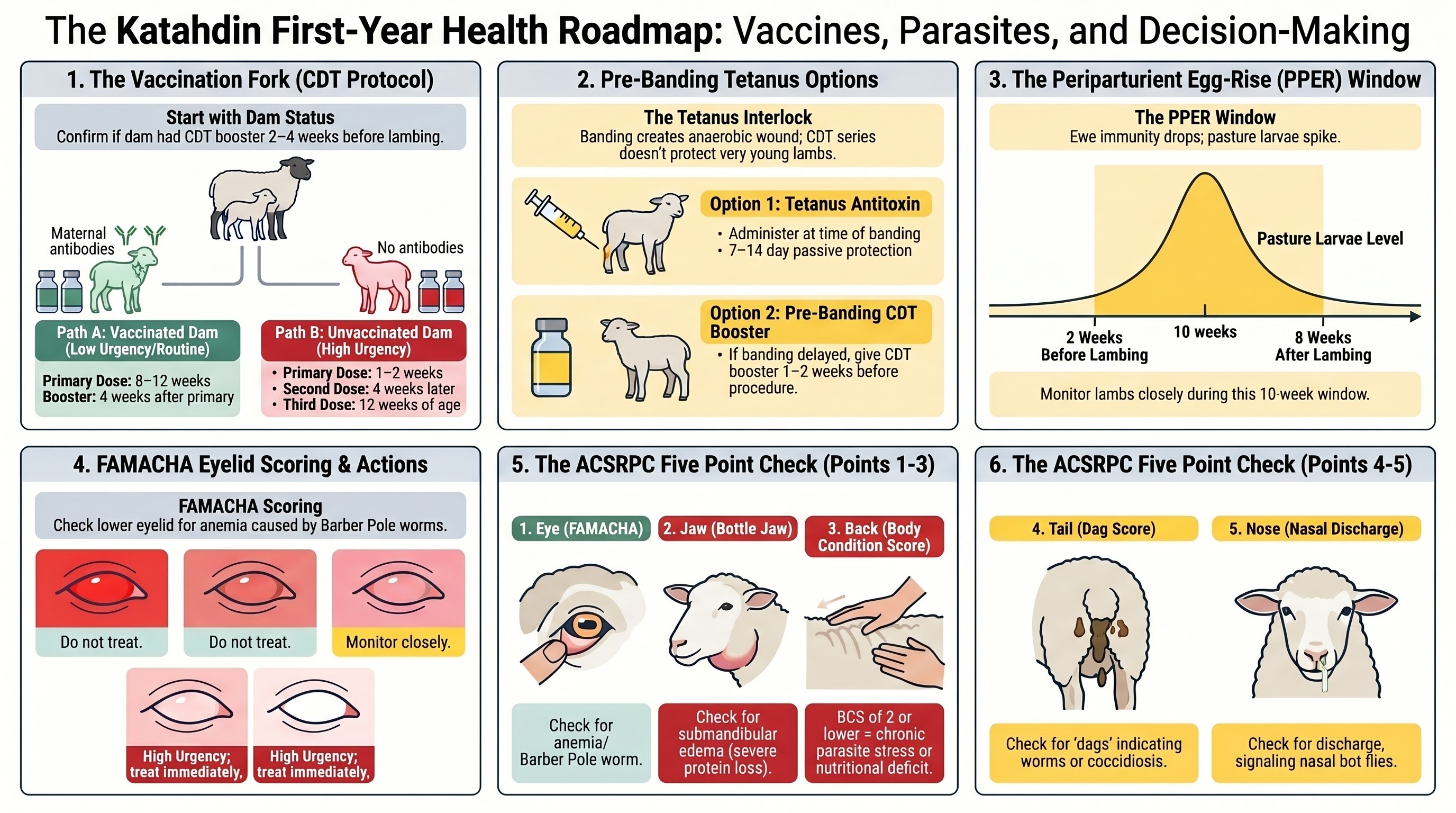
Critical limitation up front: FAMACHA detects barber pole worm only. Trichostrongylus, Teladorsagia, Nematodirus, and coccidia cause weight loss, scours, and unthriftiness without anemia. A FAMACHA-1 lamb can still be carrying a parasite load that is robbing weight gain. FAMACHA is the first screen, not the only screen.
Treatment thresholds
The ACSRPC and Mississippi State Extension protocol for sheep is unambiguous:
| FAMACHA score | Eyelid color | Action |
|---|---|---|
| 1 | Red | Do not treat |
| 2 | Red-pink | Do not treat |
| 3 | Pink | Do not treat (sheep); treat (goats, per ACSRPC PPER) |
| 4 | Pale pink | Treat |
| 5 | White | Treat - emergency level |
Scores 1 through 3 are deliberately left untreated to preserve refugia (covered in the next section). The threshold for goats is one step lower because goats lack the resistance margin sheep have - but Katahdins are sheep, and the 4-and-5 threshold applies.
Certification
FAMACHA cards cannot be purchased without certification. The program is co-administered by the University of Rhode Island and Louisiana State University School of Veterinary Medicine. Participants must be 13 or older, US or Canada residents, complete the online video module, and submit a demonstration video. The certification protects against color-perception drift - without it, a producer's eyeball calibration shifts over time and the tool becomes unreliable.
The certification fee is small. Pay it before the first FAMACHA score, not after a parasite event has cost a lamb.
First scoring age
Lambs can be FAMACHA scored from about 6 to 8 weeks of age, once they are eating substantial pasture and have moved past the dam's milk. Earlier scoring reads the lamb's pre-pasture state, which is not informative for parasite management. The first useful FAMACHA pass for spring-born Katahdin lambs in the mid-Atlantic is therefore around mid-to-late May.
The Five Point Check
ACSRPC's Five Point Check is the framework that handles the parasites FAMACHA misses. The five points, scored at the same chute pass:
- Eye - FAMACHA score for Haemonchus.
- Jaw - bottle jaw indicates protein loss from severe parasitism.
- Body condition - BCS 2 or below indicates chronic parasite or nutrition problem.
- Dag (rear-end soiling) - diarrhea from Trichostrongylus, Teladorsagia, or coccidia.
- Nasal discharge - nasal bot fly (Oestrus ovis) signals.
A lamb with a FAMACHA-2 eye but a dag score of 3 and a body condition score of 1.5 is in worse parasitic shape than a FAMACHA-4 lamb with clean rear and BCS 3. Treat the Five Point Check failure even though the eyelid color did not flag it.
The Five Point Check converts FAMACHA from a single-axis test into a defensible whole-flock assessment. For a 20-ewe Katahdin operation running summer pasture, scoring the five points every 14 days during the high-pressure window (June through September) is realistic. Outside that window, monthly is enough.
Strategic Deworming and Refugia
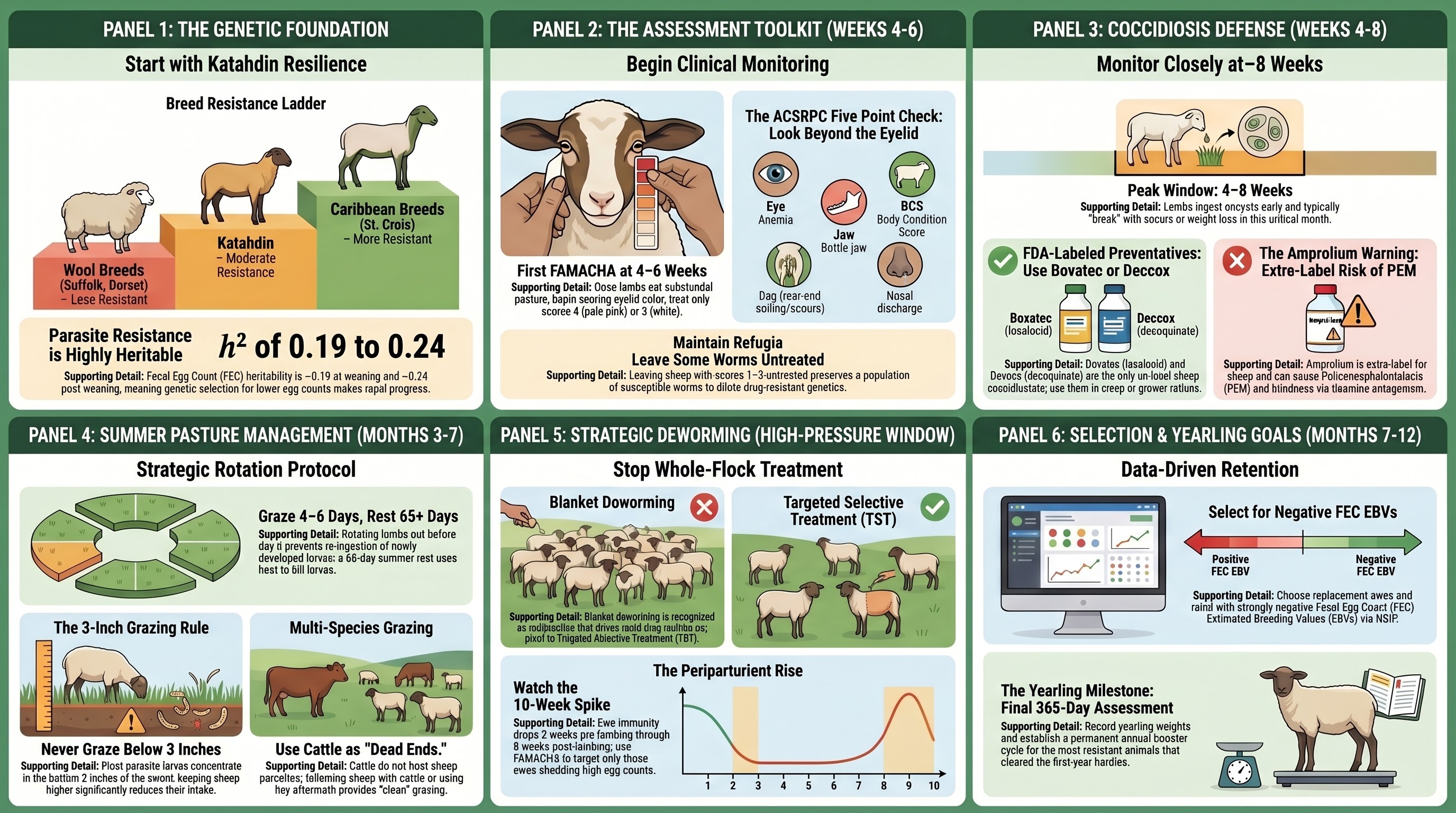
The historical default - deworming every ewe at lambing - is now recognized as malpractice. Blanket whole-flock deworming removes every susceptible parasite in one pass and selects for the resistant survivors. Within a few seasons, the dewormer that used to work no longer does, and the operation has nothing left in the chemical toolbox.
Modern protocol, supported by ACSRPC and ATTRA:
- Refugia - the population of parasites unexposed to the anthelmintic. Leaving FAMACHA-1, -2, and -3 ewes untreated maintains a susceptible breeding pool that dilutes resistance.
- Targeted selective treatment - deworm only ewes meeting specific clinical criteria: bottle jaw, FAMACHA 4 or 5, BCS 2 or below, triplet-bearing, or first-time mothers.
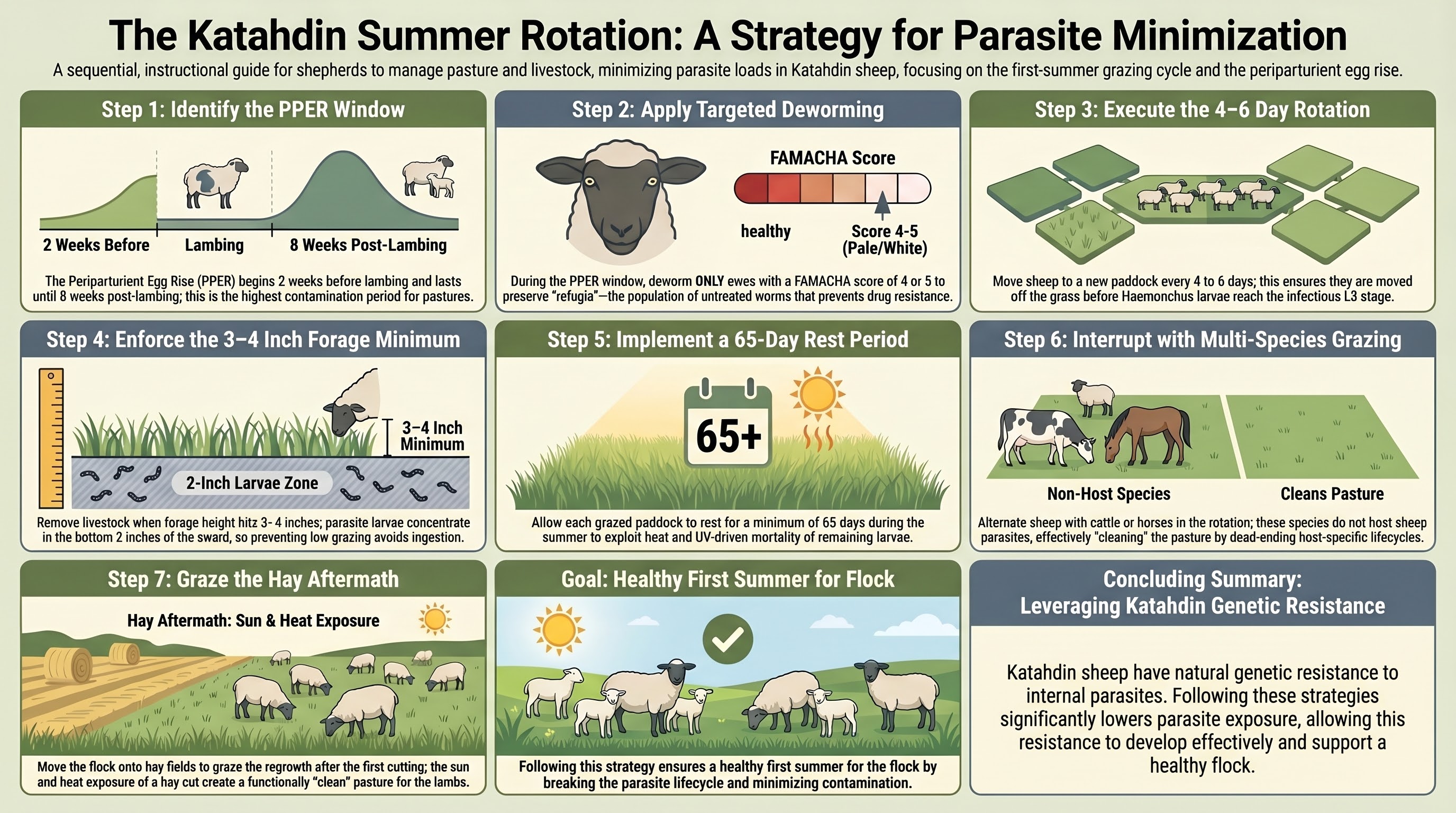
- Periparturient egg rise window - ewe immunity drops from 2 weeks pre-lambing through 8 weeks post-lambing, FEC spikes, and lambs ingest the resulting larvae from pasture. This 10-week window is where targeted treatment actually pays off.
- Late-gestation protein supplementation - bypass protein in the last 4 to 6 weeks of gestation measurably blunts the periparturient FEC spike. Distillers grains or soy-pass supplementation is a nutrition lever, not a drug lever, that aligns with refugia management.
The single sentence to internalize: refugia means leaving worms in the flock on purpose, because the susceptible worms breed with the resistant ones and dilute the resistance gene pool. Every ewe you do not deworm is a contribution to next season's drug efficacy.
Katahdin Breed Resistance and Heritability
Katahdins carry meaningful parasite resistance from their hair-breed Caribbean ancestry. The breed-resistance ladder, from most resistant to least, places them in the middle:
| Tier | Breeds |
|---|---|
| Most resistant | St. Croix, Barbados Blackbelly, Gulf Coast Native (pure Caribbean hair) |
| Moderately resistant | Katahdin (Caribbean-derived but composite) |
| Least resistant | Suffolk, Hampshire, Dorset, and other wool breeds |
This ranking is documented in ATTRA and EAPK reviews. The implication is double-edged. Katahdins start with better base genetics than wool breeds, so a producer running Katahdins on pasture has a genetic head start. But Katahdins are not St. Croix - within-breed selection on fecal egg count is still the lever that compounds the gain.
The heritability numbers from EAPK summarizing peer-reviewed work and NSIP Katahdin flock data:
- Weaning fecal egg count (WFEC) heritability: approximately 0.19, with NSIP Katahdin flock estimates as high as 0.52.
- Post-weaning fecal egg count (PFEC) heritability: approximately 0.24, with select-flock estimates up to 0.50.
- Genetic correlation between WFEC and weaning weight: favorable (negative) - selection for lower FEC does not penalize growth. Lambs with lower egg counts also wean heavier.
The decision implication for a 20-ewe operation: ram selection on negative FEC EBVs through NSIP enrollment is the single most efficient genetic lever available. A purchased ram with a strongly negative WFEC EBV moves the resistance distribution of every lamb crop he sires, and that move is permanent in the genetic pool of the flock as long as his daughters are retained.
This is also where the rejection of the historical concern matters. The old worry was that selecting for parasite resistance would shrink the frame of the lambs. The genetic correlation says the opposite: low-FEC lambs are also heavier-weaning lambs. Index selection on FEC EBV does not sacrifice market lamb performance.
Coccidiosis Prevention
Coccidiosis is a different parasite problem with a different management calendar. Eimeria protozoa have a 2 to 3 week prepatent period - a lamb born clean ingests oocysts in the first weeks of life and breaks with disease at 4 to 8 weeks of age. Clinical signs are dark or bloody scours, unthrifty appearance, and weight loss. The Merck Veterinary Manual is the standard reference.
The risk is highest in lambs born indoors, in high-stocking-density jugs and lots, or on pastures with heavy lamb traffic from the prior season. Pasture-born Katahdin lambs at low stocking density on rotated pasture face the lowest risk. The decision tree:
FDA-labeled options
Two products are labeled for sheep coccidiosis in the United States:
- Bovatec (lasalocid) - 15 to 70 mg per sheep per day, FDA-approved for confined sheep. Delivered as a feed additive in creep or grower rations.
- Deccox (decoquinate) - 100 mg per kg of feed (use 60 g per kg premix at 1.67 kg per ton), labeled for young non-lactating sheep and goats.
Either of these is the default first-choice when coccidiosis prevention is required. They are labeled, withdrawal times are established, and the producer does not need a vet's off-label paperwork.
Extra-label alternatives and the amprolium warning
Amprolium (Corid) is widely discussed in small-ruminant forums but is extra-label in sheep. It carries a real welfare risk: amprolium is a thiamine analogue, and at higher or extended doses it induces polioencephalomalacia (PEM) - neurologic disease, blindness, opisthotonos. The Merck Veterinary Manual cites 50 to 55 mg per kg orally every 24 hours for 5 days as an extra-label regimen. Use only under VCPR with a FARAD-derived withdrawal time.
The decision rule: if a labeled coccidiostat (Bovatec or Deccox) covers the situation, use it. Reach for amprolium only when a vet has assessed the case, prescribed the dose, and supplied thiamine supplementation alongside.
Sulfadimethoxine and tetracyclines are alternative extra-label treatment paths under the same VCPR rule.
When coccidiosis prevention is worth running
The honest answer for a 20-ewe pasture-based operation: probably not in most years. Lambs born on clean rotated pasture in late winter or early spring, weaned to fresh pasture at 60 days, rarely break with clinical coccidiosis. The exceptions are:
- Lambs held in jugs and lots beyond 5 to 7 days (a Part 3 scenario).
- Pastures that carried heavy lamb traffic the prior year and have not had a long rest.
- A wet spring with high stocking density and limited rotation.
The default for a clean pasture-based operation is no coccidiostat in feed, with monitoring through the Five Point Check during the 4-to-8-week peak risk window. If a lamb breaks with bloody scours, the response is a vet-call, fecal float to confirm, and labeled coccidiostat in the affected age group's ration.
First-Summer Grazing Rotation
Pasture management is the parasite intervention with the largest payoff and the lowest input cost. The biology drives the rules.
Haemonchus contortus L3 larvae develop on pasture in 4 to 5 days after egg deposition. Rotating animals out of a paddock before day 6 prevents re-ingestion of the larvae the same animals just deposited. Summer rest periods of 65 days or more exploit heat and UV mortality of L3 larvae, though cool moist conditions can extend larval survival to 120 days.
The Penn State Extension and Ohio State Small Ruminant Team rules:
- Grazing periods of 4 to 6 days per paddock during the high-parasite-pressure season (May through September in the mid-Atlantic).
- Rest periods of 65 days or more in summer, longer in cool wet conditions.
- Grazing height 3 to 4 inches minimum. The bottom 2 inches of the sward concentrates the larval population. Lambs grazing into the dirt ingest a disproportionate parasite load.
- Multi-species grazing or leader-follower rotations. Cattle and horses do not host sheep and goat GI nematodes - co-grazing or follower rotations dilute and dead-end the parasite life cycle.
- Hay aftermath. Hay-cut paddocks expose larvae to lethal sun and heat. Grazing aftermath several weeks after a hay cut is functionally a clean pasture. Both multi-species and aftermath rotations are practical mid-Atlantic tools given a 42-acre footprint.
The combined rotation rule for a small operation: 4 to 6 day grazing, 65-plus day rest, never below 3 inches, weave in cattle aftermath or hay aftermath whenever the calendar permits. That single sentence carries more parasite-load reduction than any chemical protocol.
What This Looks Like on a 20-Ewe Operation
A typical first-year health calendar, assembled from the protocols above:
| Month | Lamb age | Action |
|---|---|---|
| March | 0 to 4 weeks | Lambing, colostrum, navel dip, optional birth weight. Banding on AVMA stratified architecture with antitoxin or pre-banding CDT booster. |
| April | 4 to 8 weeks | First Five Point Check pass; coccidiosis monitoring; pasture rotation begins. |
| May | 6 to 10 weeks | First CDT primary (vaccinated-dam protocol). Weaning at 60 days for NSIP. |
| June | 10 to 14 weeks | CDT booster 3 to 4 weeks after primary. Five Point Check every 14 days. |
| July through September | 16 to 28 weeks | High parasite pressure. Five Point Check every 14 days. Targeted FAMACHA-4-or-5 deworming only. Rotation discipline at 4 to 6 day grazing, 65 day rest. |
| October | 28 to 32 weeks | First post-pasture FAMACHA. Reduce scoring frequency. |
| November to December | 30 to 40 weeks | Pre-breeding visit for retained ewe lambs at 7 to 9 months: annual CDT booster, FAMACHA, BCS, flushing begins. Joining at BCS 3.0 to 3.5. |
| March (year 2) | 52 weeks | Yearling weight for NSIP. Annual booster cycle established. |
That schedule fits one beginning farmer doing all the chute work, with no helpers, on 42 acres. It is calibrated to a clean farm, no orf history, no documented footrot, no abortion outbreak, and a closed flock with vetted ram introductions through NSIP-enrolled sources.
The schedule is also calibrated for a farm that intends to enroll in NSIP. If the operation does not enroll, the weaning and yearling weights become optional, but the CDT and FAMACHA protocols stay exactly the same. Vaccine and parasite protocols are not contingent on NSIP enrollment - they are contingent on running sheep at all.
The Honest Limits
Three limits deserve naming before closing.
Katahdin-specific monthly average daily gain curves are not well-published. NSIP Katahdin flocks have proprietary growth-curve data, but the breed-wide ADG-by-month reference does not exist in extension literature. Part 6 covers what is available and documents the gap.
FEC EBV percentile cutoffs - what counts as a "good" negative EBV - are behind the NSIP member portal. Producers planning ram purchases should consult the breeder's actual NSIP report rather than relying on published rules of thumb.
Cumberland County rabies-variant prevalence is not publicly mapped at sub-state resolution. Virginia Department of Health and Virginia Department of Wildlife Resources publish state-level reports; for county-specific exposure context, the local large-animal vet is the authoritative source.
These limits are real. They do not change the protocols above, but they should change a beginning farmer's expectations about how confidently any given decision can be made from public sources alone. The vet relationship and the NSIP membership are the two paid subscriptions that close most of the gap.
What Part 6 Covers
Part 6 picks up where the health protocols leave off. The topics:
- NSIP weighing milestones and EBV interpretation - birth, 60-day weaning, 120-day post-weaning, late-post-weaning, and yearling. What each weight enables. How to read EBV reports for ram selection.
- Growth curves and weaning nutrition - creep feed decisions, weaning age tradeoffs, and the difference between a market lamb finishing schedule and a replacement ewe lamb growth curve.
- Selection-stage decisions - the USA Hair Index from EAPK Fact Sheet #5, body condition gates for retained ewe lambs, ram selection criteria, and the cull-tag conversation for chronic underperformers.
Together with Parts 1 through 5, that closes the calendar from pre-lambing preparation through the first breeding season of the next generation. Keep the printouts in the barn. Add to them every season.
Series navigation: Part 1: Preparation and Supplies - Part 2: Delivery and Complications - Part 3: Rejection and Bottle Lamb Care - Part 4: First-Weeks Procedures - Part 5 (this post) - Part 6: NSIP, Growth, and Selection
Download the full first-year health slide deck: Katahdin First-Year Health (PDF)
This article synthesizes guidance from Mississippi State University Extension (CDT vaccination, sustainable parasite control), Michigan State University Extension (CDT timing), Ohio State University Small Ruminant Team (orf, footrot, pre-banding tetanus protocol), Penn State Extension (grazing parasite management), the Merck Veterinary Manual (coccidiosis, amprolium PEM risk), the American Consortium for Small Ruminant Parasite Control (FAMACHA, Five Point Check, refugia, periparturient egg rise), the Eastern Alliance for Production Katahdins (breeding preparations, parasite-resistance heritability), the University of Rhode Island and Louisiana State University SVM (FAMACHA certification), USAHA committee documentation (Footvax US availability), AVMA AMDUCA guidance, FARAD, ATTRA's parasite-management publication, Boehringer Ingelheim and Drugs.com (IMRAB Large Animal labeling), and Texas Veterinary Medical Foundation (orf zoonotic risk). It is intended as educational reference: always consult your veterinarian for medical decisions specific to your flock.