Katahdin Lambing Part 4: First-Weeks Procedures
Castrate within seven days, or do not castrate yet. The seven-day mark is the cleanest line in the whole post-natal calendar, and missing it changes which tools you are allowed to use, which drugs you owe the lamb, which paperwork your veterinarian needs to file, and how long you have to wait before that lamb can enter the food chain. The same holds for ear tagging on a different schedule, and the same holds again for the federal scrapie tag whose color and material the USDA dictates whether you read the rule or not. This article is the procedural playbook for the first weeks of life: castration architecture, pain management, the federal identification program, KHSI conventions, tag mechanics, and the tail-docking question Katahdin owners get to skip entirely.
Part 1 covered preparation: nutrition, supplies, facilities, and the calendar. Part 2 covered the labor itself and the first 72 hours. Part 3 covered the cases where the bond does not form on its own - rejection, grafting, and the bottle-lamb playbook. This article picks up where the bond is sound, the lamb is nursing, and the next decision is what to do to the body of the animal in the days and weeks that follow. Most of these procedures are optional in the sense that no law forces you to perform them today. None of them are optional in the sense that running a flock without making the decisions consciously will cost you money, welfare points, or both.
The AVMA Stratified Castration Architecture
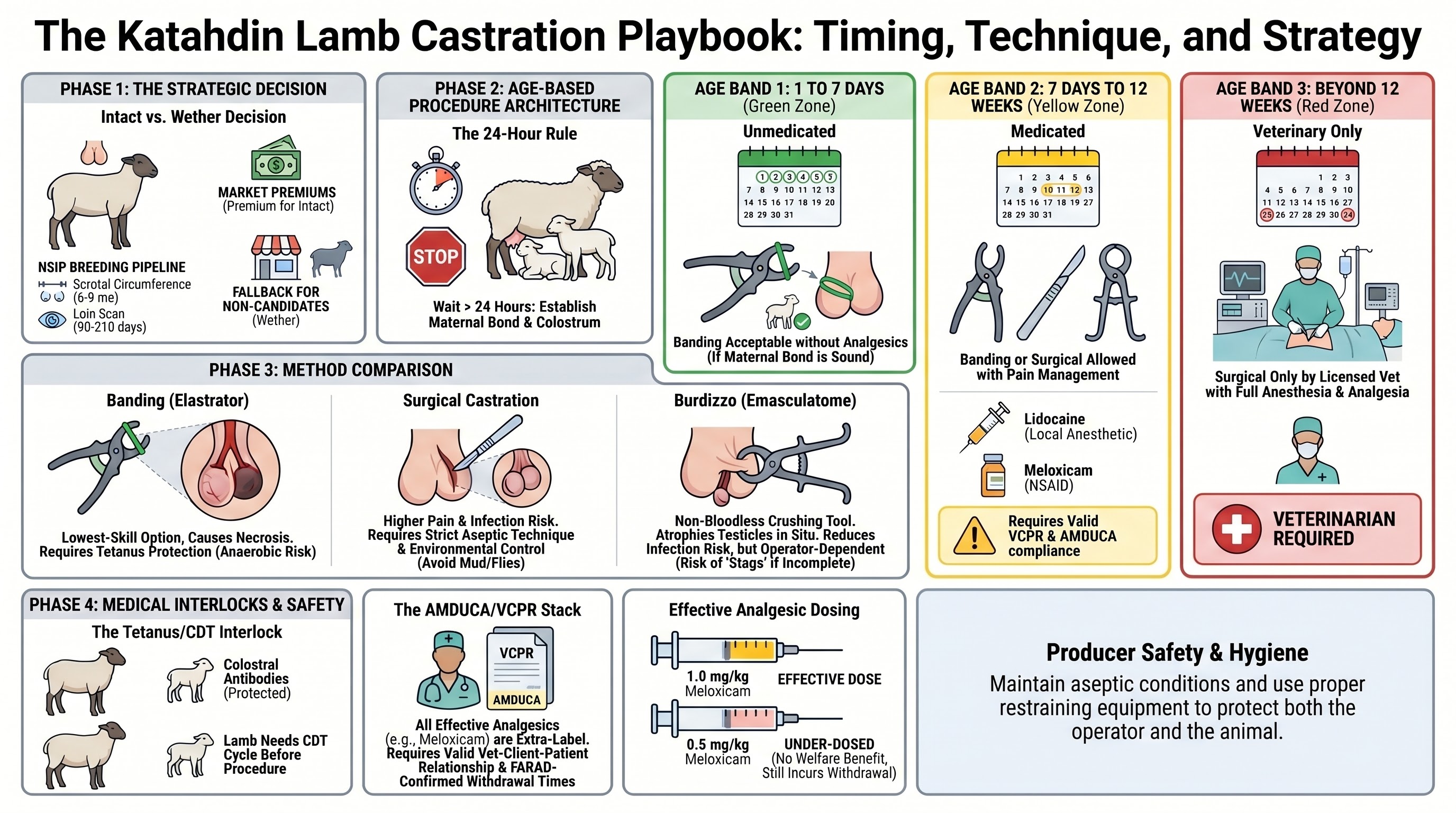
The American Veterinary Medical Association's policy on sheep and goat castration is the framework every other recommendation hangs on. It is short, and it is unambiguous. Castrate as early as practicable, but only after the maternal bond has been established and adequate colostrum intake has been achieved - meaning after 24 hours of age. From 24 hours to 12 weeks of age, banding, Burdizzo (clamping), or surgical castration are all acceptable methods. Beyond 12 weeks, only surgical castration is permitted, and only by a licensed veterinarian. The 12-week mark is therefore the operative cutoff for any on-farm decision: cross it, and the procedure leaves your hands and enters the vet's. (Source: AVMA sheep and goat castration policy.)
The AVMA layers a second requirement on top of the age architecture: all castration methods cause pain and distress, and pain management is required for all of them. The policy specifies the use of "approved or AMDUCA-permissible clinically effective anesthesia and analgesia medications." It separately requires tetanus prophylaxis prior to surgical castration. This makes CDT vaccination status - covered in Part 1 and revisited later in this article - a direct gate on whether a given lamb can be surgically castrated on a given day.
The University of Illinois College of Veterinary Medicine, summarizing American Association of Small Ruminant Practitioners (AASRP) clinical guidance, draws the age architecture even more finely. Banding before seven days of age is acceptable without analgesics, after colostrum intake is confirmed. Banding from seven days to twelve weeks requires local anesthetics and/or NSAIDs. Surgical castration after seven days requires both anesthesia and analgesia. Animals over twelve weeks must be performed by a veterinarian with appropriate pain management. (Source: University of Illinois College of Veterinary Medicine.)
The combined architecture, in tabular form:
| Lamb age | Banding | Surgical | Burdizzo | Pain management required |
|---|---|---|---|---|
| Under 24 hours | No - wait for bond and colostrum | No | No | n/a |
| 24 hours to 7 days | Yes, no analgesia required | Yes, with anesthesia and analgesia | Yes, with consideration of pain management | None for banding; full for surgical |
| 7 days to 12 weeks | Yes, with local anesthetic and/or NSAIDs | Yes, with anesthesia and analgesia | Yes, with pain management | Required for all methods |
| Over 12 weeks | Not permitted on-farm | Veterinarian only, with full pain management | Not permitted on-farm | Required, veterinarian-administered |
Susan Schoenian's Maryland Small Ruminant page documents both the recommendation (band within 1 to 7 days of age) and the reality (US producer survey average is 22.3 days). For a beginning Katahdin operation, the 1-to-7-day target is the lowest-pain pathway and the one that aligns AVMA, AASRP, and extension guidance simultaneously. (Source: Maryland Small Ruminant Page - Tail Docking, Castration, and Disbudding.)
Banding, Surgical, and Burdizzo Compared
Banding (Elastrator)
A small heavy rubber band is applied above the testicles using an elastrator tool, occluding blood supply to the scrotum and testes. Necrosis follows over 7 to 14 days, and the scrotum sloughs off. No open wound is created at the moment of application, which makes banding the lowest-skill option for a producer. The catches are real. The procedure causes acute pain peaking in the first hour and persisting for hours to days. Bands occasionally fail to cover both testicles, producing a "stag" with one functional testicle. Tetanus risk is non-trivial because the necrotic tissue is anaerobic - exactly the environment Clostridium tetani prefers.
The 1-to-7-day window is doing a lot of work for the banding option. Inside that window, no analgesia is required by AVMA or AASRP guidance, the wound is small relative to the lamb, and CDT-vaccinated dams pass colostral antibody that protects the lamb during the necrosis phase. Outside that window, you owe the lamb both a local anesthetic and an NSAID, plus you need either the dam to have boostered CDT in late gestation or the lamb to be on its own CDT cycle.
Surgical Castration
A scalpel or emasculator is used to remove the testicles through an incision in the scrotum. The wound is open, drains, and heals over 10 to 14 days. Maryland Small Ruminant guidance frames surgical castration as the higher-risk option compared to banding, requiring strict aseptic technique. University of Illinois adds environmental constraints: avoid muddy or dusty environments, wet or humid weather, or periods of high fly activity. For a small Virginia flock on pasture in late April, those conditions are difficult to control. (Source: University of Illinois College of Veterinary Medicine.)
Surgical castration is the only legal option past 12 weeks, and at that age it must be performed by a licensed veterinarian. Tetanus prophylaxis is required prior to surgical castration regardless of age, per the AVMA policy.
Burdizzo (Emasculatome)
The Burdizzo is a bloodless crushing tool that occludes the spermatic cord without breaking the skin. The testicles atrophy in situ over weeks, the scrotum remains intact, and no necrotic tissue sloughs off. Compared to banding, infection and fly-strike risk are lower because there is no open wound and no necrotic mass. Compared to surgical, no incision is created. (Source: Maryland Small Ruminant Page.)
The Burdizzo's downside is operator-dependent. Incomplete crush leaves a "stag" - an animal that retains one or both functional testicles and behaves like a ram. The technique is harder to verify than banding (you cannot see whether the crush worked) and harder to verify than surgical (no testicles to confirm removed). Burdizzo is uncommon on small operations in the US for that reason; most extension materials list it as an option but few recommend it as the default.
Pain Management - The AMDUCA/VCPR/FARAD Stack
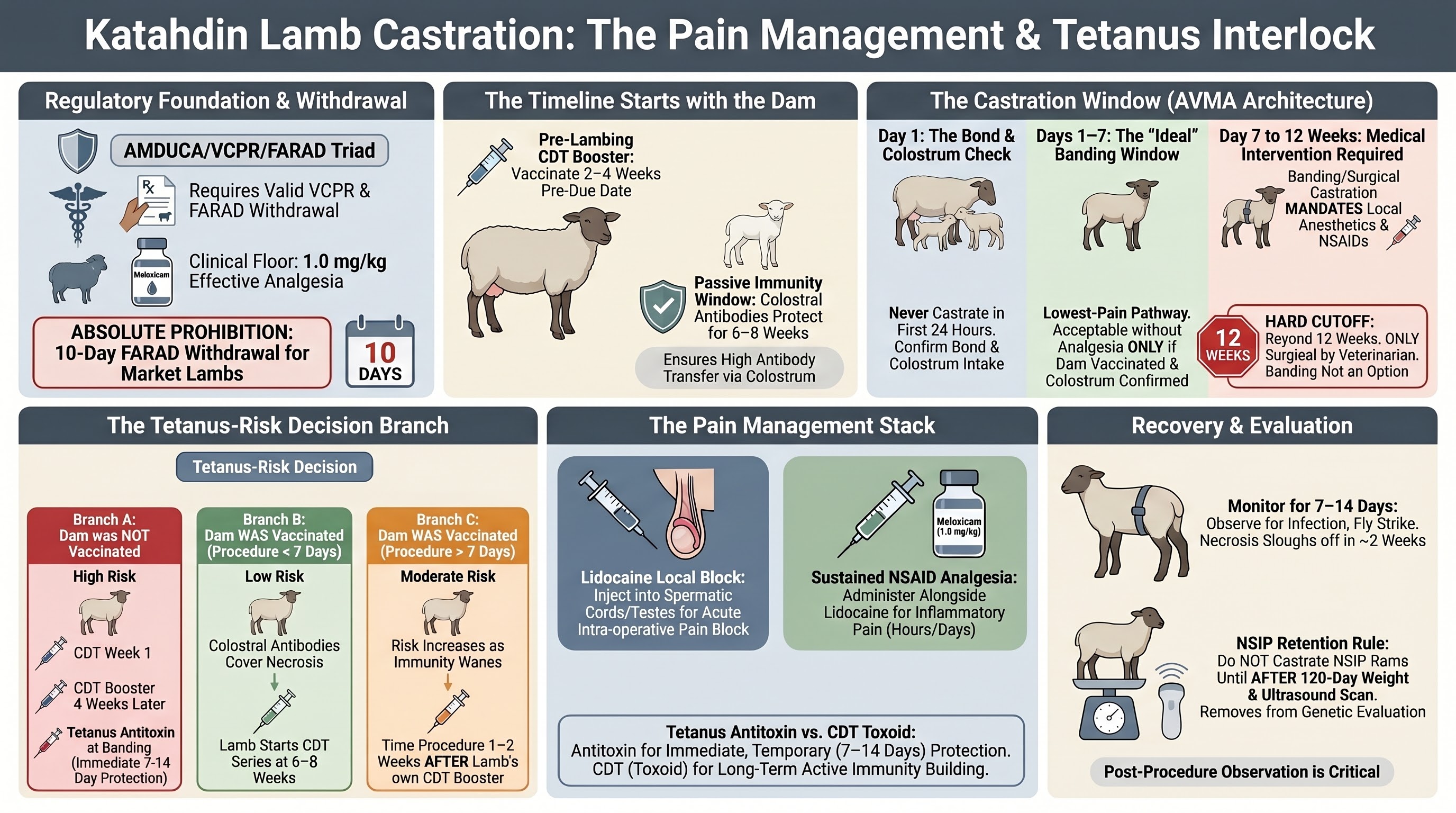
Every effective analgesic for sheep castration in the US is extra-label. There is no FDA-approved NSAID labeled for castration analgesia in sheep. Use of any of these drugs requires the Animal Medicinal Drug Use Clarification Act (AMDUCA) framework, which means a valid Veterinarian-Client-Patient Relationship (VCPR) and withdrawal times supplied by the Food Animal Residue Avoidance Databank (FARAD). The veterinarian is the gatekeeper. Producer-direct purchase of these drugs and dosing without a vet's involvement violates AMDUCA and creates regulatory exposure for the operation if any treated lamb enters the food chain.
Meloxicam
Across multiple peer-reviewed studies, 1.0 mg/kg meloxicam (oral, subcutaneous, or intramuscular) is the effective dose for analgesia during lamb castration and tail docking. Studies attempting 0.5 mg/kg in sheep showed limited analgesic effect despite achieving adequate plasma concentrations. The clinical floor is 1.0 mg/kg; under-dosing is worse than not treating because it incurs the withdrawal penalty without the welfare benefit. (Source: Meloxicam pharmacokinetics in sheep, PMC.)
A separate USDA FARAD-funded pharmacokinetic study determined a tissue withdrawal interval of at least 10 days following the last dose for market lambs treated with ten daily oral 1 mg/kg meloxicam doses. The withdrawal is calculated using FDA regulatory methods on kidney residue depletion. Single-dose castration analgesia would be different and should be confirmed by FARAD on a case-by-case extra-label submission by your veterinarian. (Source: Meloxicam withdrawal interval in lambs, PMC.)
The practical translation: a lamb dosed with meloxicam at castration cannot enter the food chain for at least 10 days following the last dose, and your veterinarian must document the extra-label use and the withdrawal interval before any of those animals reach a buyer. Build that 10-day clock into the procedure date, not the marketing date.
Lidocaine
AVMA-aligned clinical guidance pairs a lidocaine local block, injected into the spermatic cords and/or testes prior to the procedure, with a post-procedural NSAID - meloxicam or flunixin meglumine - for sustained analgesia. Lidocaine handles the acute pain of the procedure itself. The NSAID handles the inflammatory pain over the following hours and days. Both are extra-label in sheep in the US and require the AMDUCA/VCPR/FARAD stack described above. (Source: University of Illinois College of Veterinary Medicine.)
When Pain Management is Optional
Strictly: only banding within the 1-to-7-day window is recognized by AVMA and AASRP as acceptable without analgesia, and only because the maternal bond and colostrum intake are confirmed. Outside that narrow window, every other castration approach in any age band requires pain management. Treat the 1-to-7-day window as the planning default and structure the post-natal calendar around hitting it.
The CDT Tetanus Interlock
Tetanus enters the body through wounds, including castration sites. The CDT vaccine (Clostridium perfringens types C and D plus tetanus toxoid) is the standard prophylaxis. The lamb's CDT status at the time of banding or surgical castration determines whether the procedure is reasonable to perform.
The protocols fork on the dam's vaccination history. Mississippi State Extension specifies that lambs from CDT-vaccinated dams receive their first CDT at approximately 30 days post-birth, leveraging colostral antibody during the gap. Lambs from unvaccinated dams receive their first CDT in week one of life, with a booster four weeks later. (Source: Mississippi State Extension - CDT Vaccination.)
Cooperative extension at Ohio State and Michigan State recommends boosting CDT 1 to 2 weeks before banding or docking so antibody titer peaks at the time of wound creation. Ewes and does should be vaccinated in the last month of pregnancy. (Source: Michigan State University Extension.)
The interlock for Epic Pastures or any small operation:
| Dam CDT status | Lamb banded at 1 to 7 days | Lamb banded at 7+ days |
|---|---|---|
| Vaccinated, last month of gestation | Colostral antibody covers the necrosis phase | Lamb's own CDT cycle must be timed to peak before the procedure |
| Unvaccinated | Tetanus risk elevated; consult vet, consider tetanus antitoxin | Lamb's CDT cycle (first dose week 1, booster week 5) must complete before any wound |
The cleanest path is: vaccinate dams in the last month of gestation (covered in Part 1), band lambs within 1 to 7 days of age, and the colostral antibody plus the small wound size combine to make tetanus risk minimal without further intervention. Drift outside that path and the protocol gets noticeably more complicated.
Wether or Intact - The NSIP and Market Decision
Castration is irreversible. Before you reach for the elastrator, decide whether the lamb belongs to the wether population at all. The answer turns on two questions: is this lamb a candidate for retention or sale as breeding stock under the National Sheep Improvement Program (NSIP), and does your market channel pay a premium for intact ram lambs.
NSIP and the Ram-Lamb Trait Pipeline
NSIP collects two trait categories that cannot be measured on a wether. Eastern Alliance for Production Katahdins documents both. Scrotal circumference is taken at post-weaning, approximately 6 to 9 months of age. Carcass measurements via ultrasound - loin eye depth, fat cover - occur between 90 and 210 days of age, often paired with a post-weaning weight at 120 to 150 days. (Source: Eastern Alliance for Production Katahdins data collection.)
The implication is direct: any ram lamb under NSIP selection consideration should remain intact through at least the 120-day post-weaning weight and ultrasound scan, with castration deferred until the keep/cull decision is made. Castrate too early and you remove the animal from the individual genetic evaluation pipeline, even if his data still informs family evaluations. (Source: Eastern Alliance for Production Katahdins NSIP.)
NSIP weaning weight is collected at average 60 days, with a 45-to-90-day inclusion window. A banded lamb that loses weight from procedural stress in the days before weigh-in introduces noise into the EBV calculation. The cleanest schedule is to band well before weighing - at 1 to 7 days, with recovery complete by weigh-day - or defer past the weigh-day entirely. Mid-window banding is the worst option, both for the EBV data and for the lamb. The 12-week age cap then forces the deferred-castration decision back into your hands well before it leaves them: anything not banded by 12 weeks must go to a vet for surgical castration, or the animal must be marketed intact.
The Eid al-Adha Premium
Maryland Small Ruminant guidance documents that ethnic buyers, particularly serving Muslim Festival of Sacrifice (Eid al-Adha) demand, often prefer intact males and may pay a premium price. (Source: Maryland Small Ruminant Page.) Eid al-Adha follows the lunar Islamic calendar and falls roughly 11 days earlier each Gregorian year. For a Virginia operation lambing in mid-April, lambs born in 2026 will be approaching the Eid al-Adha sale window in late spring of 2027 at about 12 to 14 months of age - the right size and age for the market.
The two decisions interlock cleanly. A ram lamb retained intact for NSIP measurement at 120 to 210 days remains a candidate for the intact-male market channel without a second decision. The ones that wash out of NSIP selection at the 120-day weigh-in can either go to slaughter intact (subject to channel rules) or, if the marketing window is far enough in the future, be surgically castrated by a veterinarian after 12 weeks. The wether decision is, in practice, less a default than a fallback for lambs that fit neither the breeding nor the intact-male market.
USDA APHIS Scrapie Program
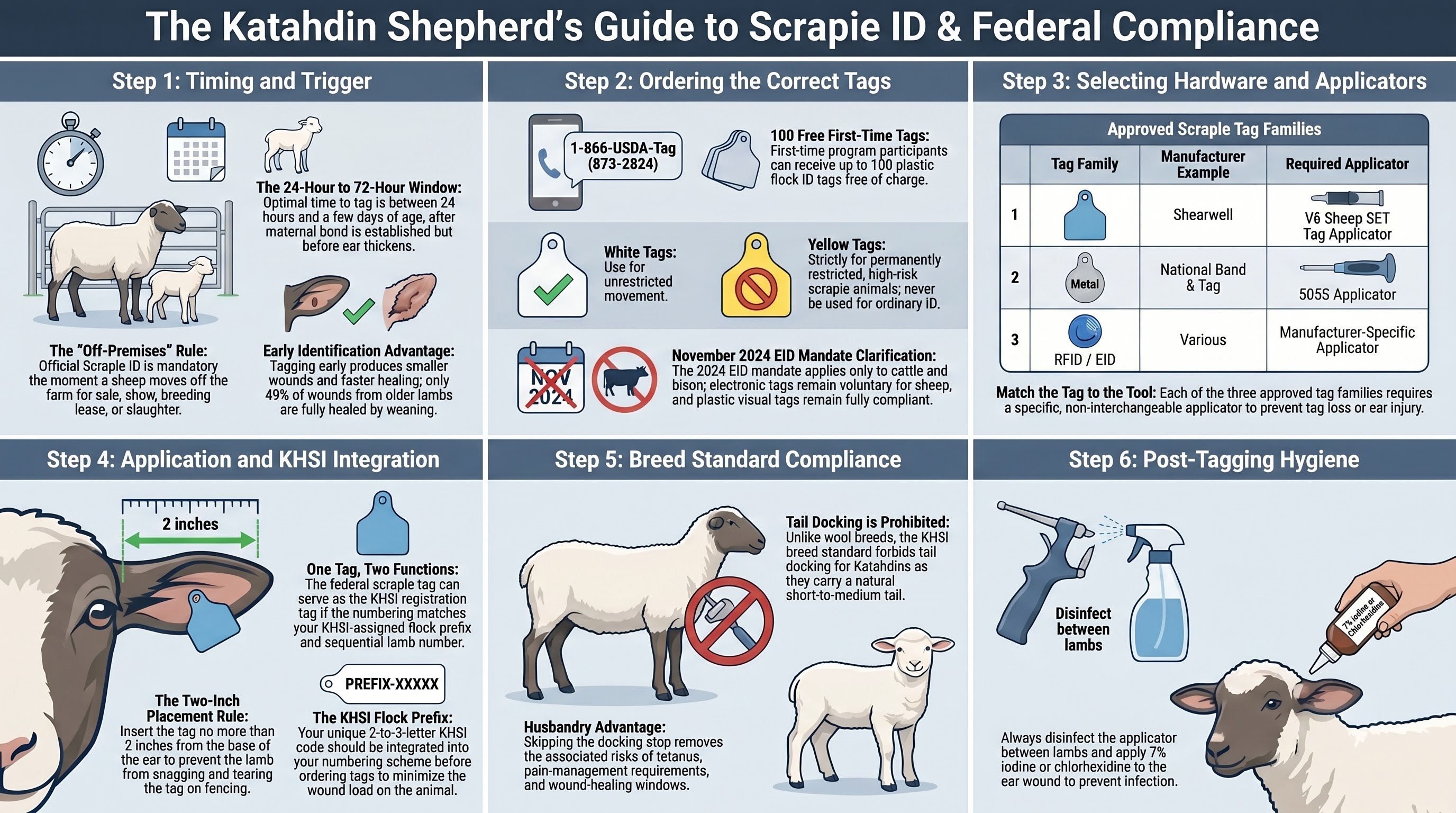
The federal scrapie identification program is the one regulatory layer no Katahdin owner can skip. It applies on the day a sheep moves off the premises of origin - for sale, for show, for breeding lease, for slaughter, for any reason at all. The producer's job is to have the right tag in the right ear before the gate opens.
What Triggers the Requirement
All sheep and goats must have official ID when moving off their premises of origin. Federal exceptions are limited: sheep under 18 months in slaughter channels and certain intrastate movements between non-commerce-engaged owners. Tattoos may not be used as the sole form of official ID for animals moving to slaughter or through a livestock market. States may impose stricter rules. Pennsylvania, for example, requires identification for all sheep and goats leaving the farm regardless of age, exceeding the federal 18-month threshold. (Sources: USDA APHIS Scrapie Program; Penn State Extension.)
For Epic Pastures, any sale, show, breeding lease, or off-farm movement triggers the requirement. Plan to tag every lamb you intend to sell or move before they leave the farm.
Approved Tag Types
USDA APHIS approves three official tag families for sheep and goat identification. Each requires a specific applicator, and buying tags without verifying applicator compatibility is a common first-time error.
| Tag type | Manufacturer example | Applicator |
|---|---|---|
| Plastic | Shearwell | V6 Sheep SET Tag Applicator |
| Metal | National Band & Tag | 505S applicator |
| RFID/EID | Various | Manufacturer-specific |
(Source: USDA APHIS Scrapie Tag Program.)
Free First-Time Tags
The National Scrapie Eradication Program provides up to 100 plastic flock ID tags free of charge to first-time participants in the sheep and goat identification program, while available funds are expended. For a 20-ewe Katahdin operation, 100 tags is enough to cover full first-year identification including all ram lambs and replacements. The ordering line is 1-866-USDA-Tag (873-2824). (Source: USDA APHIS.)
Tag Color - White vs Yellow
White tags are applied to sheep and goats that meet the requirements to move for any purpose. Yellow tags are applied only to retained, permanently restricted scrapie high-risk animals. Producers should never voluntarily use yellow tags from another supply for ordinary identification purposes. The color is a compliance signal, not an aesthetic choice. (Source: USDA APHIS.)
RFID Is Not Mandatory for Sheep in 2026
The USDA's animal disease traceability final rule, effective November 5, 2024, requires visually-and-electronically-readable eartags only for certain classes of cattle and bison moving interstate. APHIS encourages - but does not require - electronic identification for sheep and goats. Plastic visual-only tags remain fully compliant for all federal scrapie purposes today. (Source: USDA APHIS Animal Disease Traceability.)
The November 2024 mandate is for cattle and bison. Read the source material before paying a premium for RFID hardware that the regulation does not yet require.
KHSI Registration Tagging
Katahdin Hair Sheep International (KHSI) requires every registered animal to be continuously identified by ear tag, tattoo, or other permanent identification. The numerical portion must match the Flock Tag ID on the registration or recordation certificate. A unique 2-or-3-letter flock prefix is assigned by KHSI Operations and appears on both the certificate and the animal's ear tag. (Source: Katahdin Hair Sheep International.)
The practical consequence is that the federal scrapie tag and the KHSI registration tag can be the same physical tag if the numbering matches. One tag, two compliance functions. The alternative - a separate registration tag plus a separate scrapie tag in different ears - is more labor and more wound load on the lamb. Plan the numbering scheme before you order tags. The KHSI flock prefix plus a sequential lamb number is a clean format that satisfies both APHIS and KHSI without duplicating hardware.
Tail Docking - The Procedure Katahdin Owners Skip
The KHSI breed standard makes tail docking unnecessary on Katahdin lambs. The breed naturally carries a short-to-medium tail that does not predispose to fly strike or breeding interference. (Source: Baalands Katahdin FAQs.)
This removes an entire procedure from the post-natal task list compared to wool breeds. Tail docking would otherwise carry its own CDT timing requirement, its own pain-management requirement, its own wound-healing window, and its own risk profile. Katahdin owners get to skip all of it.
The instruction is therefore explicit: do not dock Katahdin tails. Some homesteading lore conflates Katahdins with wool breeds and recommends docking out of habit. The KHSI breed standard says no. Follow the standard.
Ear Tag Mechanics
Timing
Premier1 and extension consensus place the optimal tagging window between 24 hours and a few days of age, after the maternal bond is established. Earlier tagging produces smaller wounds, faster healing, and lower infection risk than tagging older lambs. Tag placement should be no more than 2 inches from the base of the ear, because going farther from the head increases the likelihood that the sheep will tear the tag on fencing. (Source: Premier1 Supplies - Inserting Ear Tags.)
Wound Healing Reality
A 2025 Scientific Reports study tracked lamb ear-tag wound healing under typical pasture conditions. Only 49 percent of ear-tag wounds had healed by weaning, observed at 8 to 11 weeks post-tagging. Twenty-one percent of wounds showed pus at least once during the observation period. (Source: Scientific Reports 2025 - Lamb ear tag healing.)
The takeaway is operational. Tagging is not an instant procedure. Flies, fence rubbing, and re-handling delay healing well beyond the day of application. Three rules follow:
- Tag early. Smaller wounds heal faster than larger ones. The 24-hour-to-few-days window minimizes wound size relative to ear thickness.
- Tag once. Re-tagging means re-piercing, which doubles the wound burden. Choose the official tag from the start, or use the double-tag strategy below.
- Avoid peak fly season for any retag. Late spring through early summer in Virginia is the worst window for fresh wounds. Plan tagging early enough that wounds close before fly pressure peaks.
Application Technique
Disinfect the applicator and the tag before each use. Position the tag to penetrate the cartilage between the major blood vessels of the ear. Squeeze the applicator firmly and release. Do not reuse a tag that has been pierced and removed - the bent shaft increases tearing risk on the second application. Spray or dip the wound with iodine or chlorhexidine after tagging to reduce infection.
Double-Tagging Strategy
Allflex and extension guidance on double-tagging recommends a small tag at birth - creating the hole and providing immediate flock-level identification - plus a later larger official tag in the same hole. This avoids piercing twice and ensures that even if the small tag is lost, a clean hole remains for the official tag. The strategy is compatible with the USDA scrapie program because only the official tag must meet APHIS criteria. (Source: Allflex - Double-tagging lambs at birth.)
For Epic Pastures, the double-tag pattern fits cleanly: small management tag at 24 to 72 hours of age, official scrapie tag added at the same site between 30 and 60 days when the ear has thickened and the lamb is closer to weaning. The official tag handles federal compliance. The management tag handles the daily-operations question of which lamb is which while the official tag is still pending.
Combined Procedure Calendar - The First 90 Days
The simplest way to keep all of this organized is a calendar that anchors every procedure to the lamb's age and the dam's CDT status.
| Lamb age | Procedure | Notes |
|---|---|---|
| 0 to 24 hours | Establish bond, confirm colostrum intake | No procedures yet |
| 24 to 72 hours | Apply small management ear tag | Smaller wound, faster healing |
| 1 to 7 days | Band castrate (if wether candidate) | No analgesia required; CDT-vaccinated dam covers tetanus risk |
| 7 days | First CDT for lambs from unvaccinated dams | Followed by booster at week 5 |
| 30 days | First CDT for lambs from vaccinated dams | Primary dose; booster 3 to 4 weeks later |
| 30 to 60 days | Apply official APHIS scrapie tag | Match KHSI numbering if applicable |
| 45 to 90 days | NSIP weaning weight (target 60 days) | Avoid procedural stress in the days before |
| 90 to 210 days | Ultrasound for loin eye depth and fat cover | Ram lambs only; intact required |
| 120 to 150 days | NSIP post-weaning weight | Optional but useful |
| 6 to 9 months | Scrotal circumference (NSIP) | Ram lambs only; intact required |
| 7 to 9 months | Pre-breeding annual CDT for retained ewe lambs | Per Eastern Alliance for Production Katahdins guidance |
The cleanest path through the calendar is the one that minimizes procedure days, minimizes drug withdrawals, and keeps NSIP candidates in the pipeline long enough to generate their data. For most Katahdin lambs on a small operation, that path is: bond and colostrum on day one, management tag in the first three days, band-castrate the non-NSIP candidates in the first week, official scrapie tag at 30 to 60 days, and let the NSIP candidates run intact through the post-weaning measurements.
Common Errors Worth Anticipating
A short inventory of failures the literature documents and the calendar above prevents:
- Banding past 7 days without analgesia. AVMA and AASRP both classify this as inadequate pain management. The fix is hitting the 1-to-7-day window or paying the meloxicam-plus-lidocaine cost outside it.
- Castrating an NSIP candidate before scrotal circumference and ultrasound data are collected. The animal is removed from individual genetic evaluation. The fix is deciding the keep/cull question on the post-weaning weigh-day, not before.
- Buying tags without the matching applicator. Plastic Shearwell tags require the V6 applicator; metal tags require the 505S. Mismatched hardware leaves you with tags you cannot apply.
- Tagging deep into the ear, far from the base. Premier1's two-inch rule is a fence-tear-prevention rule, not a placement preference.
- Docking a Katahdin tail. The KHSI breed standard explicitly does not require it. Skip the procedure entirely.
- Treating the November 2024 EID rule as applying to sheep. It applies to certain cattle and bison. Plastic visual-only tags remain compliant for all federal scrapie purposes today.
- Dosing meloxicam at 0.5 mg/kg. Sub-therapeutic. The peer-reviewed effective dose is 1.0 mg/kg. Under-dosing incurs the 10-day withdrawal penalty without the welfare benefit.
- Performing surgical castration on an unvaccinated lamb without tetanus antitoxin. The AVMA policy explicitly requires tetanus prophylaxis prior to surgical castration. Without it, the operator is outside the standard of care.
What Part 5 Covers
Part 5 of this series addresses what runs after the early procedures are complete: the full vaccination calendar through the first year, parasite management with a focus on the periparturient rise and FAMACHA-driven targeted treatment, soremouth (orf) recognition and zoonotic precautions, and the strategic-deworming versus blanket-treatment decision that separates a sustainable parasite program from a resistance-driving one. The procedures in this article create wounds and shape the animal. The management decisions in Part 5 keep the animal alive long enough for any of it to matter.
Series navigation: Part 1: Preparation and Supplies - Part 2: Delivery and Complications - Part 3: Rejection and Bottle-Lamb Care - Part 4 (this post) - Part 5: First-Year Health - Part 6: NSIP, Growth, and Selection
Download the full procedures slide deck: Katahdin First-Weeks Procedures (PDF)
This article synthesizes research from the American Veterinary Medical Association, university extension services (Mississippi State, Michigan State, University of Illinois, Penn State, Maryland), peer-reviewed sources (Scientific Reports 2025, PubMed/PMC pharmacokinetic studies, USDA FARAD program), USDA APHIS, the Eastern Alliance for Production Katahdins, Katahdin Hair Sheep International, the National Sheep Improvement Program, Premier1 Supplies, and Allflex. It is intended as educational reference: always consult your veterinarian for medical decisions specific to your flock.