Katahdin Lambing Part 1: Preparation and Supplies
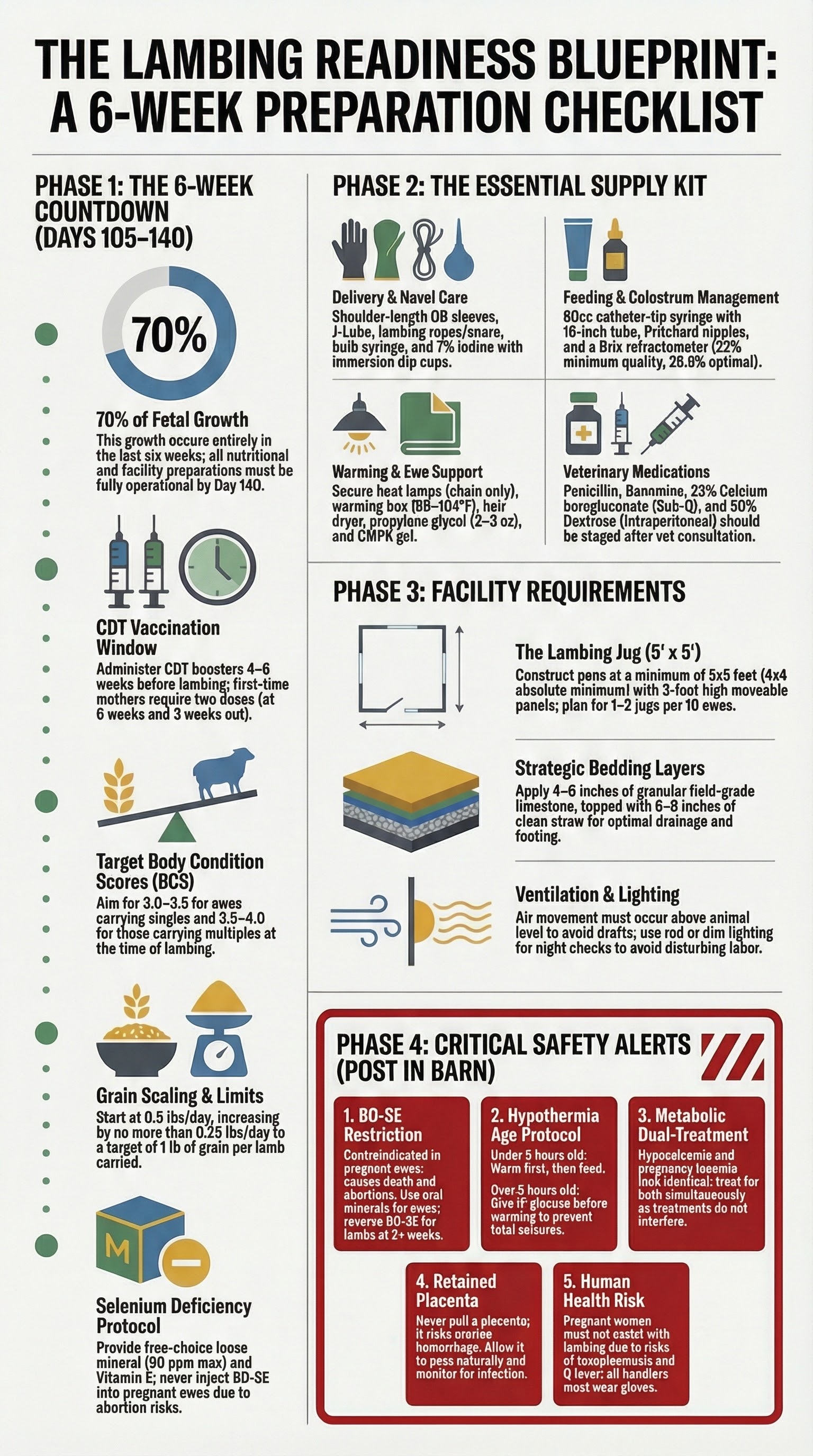
Seventy percent of fetal growth occurs in the last six weeks of gestation. That single statistic should frame every preparation decision you make before lambing season. If the barn is not ready, the supplies are not staged, and the ewes are not nutritionally supported by day 140 of gestation, you are already behind. This article covers what you need and when you need it, drawn from 106 research findings across 60+ university extension, veterinary, and breed association sources.
Start with the Calendar
Katahdin gestation averages 147 days, with a range of 142 to 152. If the ram went in on November 18, the first possible lambs arrive around April 9, with a most-likely due date of April 14. Work backward from day 140 after ram introduction. That is the date your barn, your supply kit, and your nutrition program must be fully operational. Not "mostly ready." Fully operational.
The calendar also dictates your vaccination schedule. Every ewe receives a CDT booster (Clostridium perfringens C & D plus tetanus) four to six weeks before her expected lambing date. First-time mothers require two shots: the initial dose at six weeks out, then a booster at three weeks. This is not optional. CDT vaccination transfers passive immunity to lambs through colostrum, protecting them for six to eight weeks after birth. Miss the window, and your lambs start life without that protection.
Nutrition in the Final Six Weeks
The energy demands of late pregnancy exceed what forage alone can supply. Ewes carrying multiples need grain supplementation starting four to six weeks before lambing. Singles need it by two to three weeks out. The target body condition score at lambing is 3.0 to 3.5 for singles and 3.5 to 4.0 for multiples.
Start grain at 0.5 pounds per day and increase gradually over two weeks. The target is approximately one pound of grain per lamb carried per day. Never increase more than 0.25 pounds per day - acidosis is a real risk, and it can kill a ewe faster than pregnancy toxemia.
A critical point for Katahdin owners: these are easy keepers. Overconditioning is more dangerous than underconditioning. A ewe with a body condition score above 4.0 to 4.5 faces elevated risk of pregnancy toxemia, which is exactly the condition you are trying to prevent with grain supplementation. The goal is adequate energy, not maximum energy.
The rest of the nutritional program:
- Good quality grass hay, free-choice
- Alfalfa hay introduced around day 90 of gestation for calcium, with the proportion increasing gradually
- Water at 1 to 4 gallons per ewe per day, kept above 40°F to encourage consumption (inadequate water reduces feed intake, which triggers pregnancy toxemia)
- Sheep-specific loose mineral, free-choice - not goat mineral, not cattle mineral. Copper levels differ between species. Katahdins tolerate more copper than wool breeds, but toxicity is documented. Use sheep minerals.
The Selenium Question
Many eastern US regions have selenium-deficient soils. The consequence for lambs is white muscle disease: stiff posture, inability to stand, and in the cardiac form, sudden death.
The safe approach for pregnant ewes:
- Free-choice loose mineral with selenium year-round (FDA maximum is 90 ppm in mineral)
- Vitamin E top-dressed on grain at 100 IU per ewe per day per lamb carried
- Selenium/iodine premix mixed at 1 pound to 50 pounds of plain salt
- Have hay and soil tested to establish your baseline selenium levels
One absolute prohibition: do not inject BO-SE in pregnant ewes. Deaths and abortions have been documented. BO-SE can be administered to lambs at two or more weeks of age, and it can be given at birth in selenium-deficient areas at 1 mL per 40 pounds of body weight. But not to pregnant ewes. Post this in the barn.
The Supply Kit
Assemble the full kit at least two weeks before the first expected lambing date. Scrambling for supplies at 2 AM with a ewe in labor is a failure of planning, not a rite of passage.
Delivery Supplies
- OB sleeves, shoulder-length disposable
- OB lubricant (J-Lube or SuperLube)
- Lambing ropes or chains and snare
- Clean towels, 6 to 10
- Headlamp or flashlight with fresh batteries
- Bulb syringe (available in the baby section of any pharmacy)
Feeding Equipment and Supplies
- Tube feeder: 60cc catheter-tip syringe with a 6mm x 16-inch stomach tube
- Pritchard teat nipples with soda bottles
- Frozen colostrum bank in 50 mL portions (zip-lock bags laid flat in the freezer, good for six months)
- Commercial colostrum replacer as backup only (Shepherd's Choice or Colostrx - not adequately tested in lambs, use real colostrum when possible)
- Lamb milk replacer, milk-protein based (never calf replacer)
- NutriDrench or an equivalent lamb energy supplement
- Brix refractometer for colostrum quality testing (22%+ is adequate, 26.5% is optimal, below 22% is poor)
Navel Care and Health Monitoring
- 7% iodine or chlorhexidine 2-4%, plus navel dip cups (use a cup, not a spray bottle - full immersion matters)
- Digital rectal thermometer
- Terramycin or tetracycline eye ointment for entropion
- Ear tags and applicator
- Lamb sling scale
- Record sheets, notebook, and permanent marker
Warming Equipment
- Heat lamp secured with chain and a locking connector (never twine, never rope, never wire - heat lamps are the number one cause of barn fires)
- Warming box: insulated, with a visible thermometer and ventilation holes, capable of maintaining 99 to 104°F air temperature
- Hair dryer for drying wet lambs
- Clean old towels for drying
Safer alternatives to heat lamps exist and deserve consideration: ceramic heat emitters, radiant panel heaters, and heated mats. Each eliminates the fire risk associated with traditional bulb-style heat lamps.
Ewe Support
- Molasses or Karo syrup for energy drenching
- Propylene glycol in 2 to 3 ounce doses for ketosis
- CMPK gel or drench (calcium, magnesium, phosphorus, potassium)
- Prolapse retainer spoons and harness
- Granulated sugar for reducing uterine prolapse swelling
Medications
Discuss every item on this list with your veterinarian before lambing season. Do not wait until you need them to establish the relationship.
- Penicillin or oxytetracycline
- Banamine (flunixin)
- Calcium borogluconate 23% for subcutaneous administration
- 50% dextrose for intraperitoneal glucose injections
- Oxytocin (vet-dispensed)
- Syringes: 3cc, 6cc, 12cc, 60cc
- Needles: 18-gauge and 20-gauge
Posted in the Barn
- Vet emergency phone number
- Experienced shepherd or mentor phone number
- Lambing schedule with ewe IDs and expected dates
- Critical safety alerts (printed, laminated if possible)
Facility Setup
Lambing Jugs
Build or assemble lambing jugs at minimum 5 feet by 5 feet (4 by 4 feet absolute minimum), with sides at least 3 feet high and moveable panels. Plan one to two jugs per 10 ewes. Each jug needs a flat-backed water bucket, a feed tray, and a hay bag.
Bedding
Layer 4 to 6 inches of granular field-grade limestone on the floor (not powdered limestone - the granular form is what you want), then cover with 6 to 8 inches of clean straw. Straw is preferred over shavings: it provides better footing for newborns and carries lower mastitis risk. Refresh the bedding between each ewe.
Ventilation and Lighting
Air movement should occur above animal level, not at bedding level. Lambs tolerate cold far better than they tolerate drafts and dampness. Prioritize dry conditions over warm conditions.
For lighting, use red or dim options for night checks. Full overhead lights disturb laboring ewes. This is not a minor consideration - moving a ewe or flooding her with light during early labor increases the risk of cervical complications.
Pasture and Paddock
- Manage mud aggressively: gravel or wood chips in high-traffic areas, and avoid low-lying paddocks
- Walk fence lines two to three weeks before the first expected lambing date
- Ensure predator protection is functional: livestock guardian dogs, donkeys, or llamas, plus night confinement near the barn during peak lambing
- Organize separate groups: still-to-lamb ewes, recently-lambed pairs, and older pairs ready to return to the main flock
Monitoring Technology
A barn camera with night vision (infrared LEDs) provides substantial value for the cost. Reolink Argus 3 Pro, Eufy SoloCam E40, and Wyze cameras on a hotspot all fall in the $30 to $50 range. Audio capability helps distinguish genuine labor from ordinary restlessness. A baby monitor works if the barn is close to the house.
The camera does not replace night checks. It supplements them by allowing you to assess whether a trip to the barn is warranted at 2 AM.
Pre-Lambing Ewe Assessment
Two weeks before the due date, evaluate every ewe:
- Body condition score - Is she at target? Adjust feed if needed.
- Udder - Is it developing? Asymmetric or hard tissue may indicate a mastitis history.
- Feet - Trim hooves. A lame ewe cannot position herself properly for delivery.
- Vulva - Any signs of vaginal prolapse?
- Tag - Can you read her ID from a reasonable distance?
- CDT - Was the vaccination administered four or more weeks ago?
- Deworming - What is her FAMACHA score? Treat strategically, not blanket-dose.
Critical Safety Alerts to Post in the Barn
These five items deserve permanent placement where anyone assisting with lambing can read them:
- BO-SE is contraindicated in pregnant ewes. Injectable selenium and vitamin E has caused deaths and abortions. Use oral mineral supplementation. BO-SE can be given to lambs at two or more weeks of age.
- Hypothermia treatment depends on age. Lambs under five hours old: warm first, then feed. Lambs over five hours old with severe hypothermia: give intraperitoneal glucose before warming. Warming without energy causes fatal seizures.
- Hypocalcemia and pregnancy toxemia look identical. Treat for both simultaneously - the treatments do not interfere with each other.
- Never pull a retained placenta. Pulling risks uterine hemorrhage. It will pass on its own. Contact a vet if the ewe shows signs of infection.
- Pregnant women must not assist with lambing. Risk of toxoplasmosis, enzootic abortion, and Q fever. Everyone wears gloves.
What Part 2 Covers
Part 2 of this series addresses what happens once lambing begins: recognizing the signs of imminent labor, understanding normal delivery stages, knowing when and how to intervene, managing abnormal presentations, the critical first 72 hours of newborn care, hypothermia protocols, and the complications that require immediate veterinary attention. The preparation described here is the foundation. The fieldwork described in Part 2 is where that preparation either pays off or reveals its gaps.
Series navigation: Part 1 (this post) - Part 2: Delivery and Complications - Part 3: Rejection and Bottle Lamb Care - Part 4: First-Weeks Procedures - Part 5: First-Year Health - Part 6: NSIP, Growth, and Selection
Download the full preparation slide deck: Lambing Preparation Guide (PDF)
This article synthesizes research from university extension services (Penn State, Ohio State, NC State, Mississippi State, Oklahoma State, Colorado State, Virginia Tech, Cornell, and others), the Merck Veterinary Manual, Katahdin Hair Sheep International, and the National Sheep Improvement Program. It is intended as educational reference - always consult your veterinarian for medical decisions specific to your flock.