Katahdin Lambing Part 2: Delivery and Complications
Part 1 covered preparation: nutrition, supplies, facilities, and the calendar. This article covers what happens when a ewe goes into labor and the 72 hours that follow. The preparation either proves sufficient here or it does not. There is no partial credit.
Recognizing Imminent Labor
The signs of approaching labor are reliable in Katahdins, and the absence of a wool coat makes several of them easier to observe than in wool breeds. Learn to read these signs from across the paddock. By the time you are standing next to a ewe checking ligaments, she should already be on your watch list.
24 to 48 Hours Before Delivery
| Sign | What to Observe |
|---|---|
| Udder | Firm, tight, shiny. Teats swollen and filled. The description "tight as a drum" is not metaphor - it is diagnostic. Katahdin udders are visible without lifting wool, which gives you an advantage. |
| Vulva | Swollen, elongated, pinkish to reddish. Possible clear or whitish mucus discharge. |
| Ligaments | Feel beside the tailhead. When you can wrap your fingers around with no resistance, delivery is 12 to 24 hours away. |
| Flanks | Appear hollow or sunken as the lambs drop into position. |
| Behavior | Restlessness. Pawing. Nesting. Separating from the flock. Lying down and standing repeatedly. Looking at her flanks. Lip curling. Loss of appetite within three hours of labor. |
Any single sign warrants increased monitoring. Multiple signs together mean you should not leave the property.
The Three Stages of Labor
Stage 1: Cervical Dilation (2 to 6 Hours, Up to 12)
The ewe experiences uterine contractions, but you will not see active pushing. She shifts position frequently, paws the ground, lies down and stands. A thick mucus string appears from the vulva. Contractions begin approximately every 15 minutes and progress to every 2 to 3 minutes.
The critical instruction for Stage 1: do not disturb the ewe. Do not move her to a lambing jug during early labor. Moving a ewe at this stage increases cervical complications. Observe from a distance. Prepare the jug so it is ready when she needs it, but let her labor where she chose to be.
Stage 2: Active Delivery (30 Minutes to 2 Hours)
The water bag appears or ruptures. Active, visible pushing begins. The normal delivery sequence is: water bag, front feet (soles facing down), nose resting on the legs, head, shoulders, body. A normal delivery takes 5 to 10 minutes once the lamb is engaged in the birth canal. For multiples, expect 10 to 60 minutes between each lamb.
Katahdins normally deliver quickly and without assistance. The breed's dystocia rate is approximately 5%. That is not an invitation to be absent, but it is a reason to resist the urge to intervene prematurely.
The Normal Presentation
Two front feet extending with soles pointing down. The nose and head rest on top of the legs, between the knees. This is sometimes called "the diving position."
To confirm normal presentation by feel: trace two feet with soles pointing down, follow the legs back, and find the nose between them. Front legs bend in the same direction at knee and fetlock. If the joints bend in opposite directions, those are hind legs - you are dealing with a backward presentation.
Stage 3: Placenta (2 to 8 Hours)
The uterus continues contracting, less intensely. Normal expulsion takes 2 to 3 hours, and anything up to 6 to 8 hours is acceptable. Nursing triggers oxytocin release, which aids natural expulsion. Remove the expelled placenta from the lambing area.
Never pull on a hanging placenta. The risk of hemorrhage is real and the intervention is unnecessary. If the placenta has not passed by 12 to 18 hours, monitor the ewe closely and contact a vet if she shows signs of infection.
When to Intervene
The 30-Minute Rule
| Trigger | Action |
|---|---|
| 30 minutes after the water bag appears, no feet visible | Check the ewe |
| 30 minutes of active pushing with no progress | Intervene |
| 20+ minutes of straining with nothing visible | Investigate (Katahdin breeders use this shorter threshold - Katahdins deliver fast when presentation is correct) |
| Stage 1 exceeds 8 hours | Check |
| Water bag visible for 1+ hour with no pushing | Check |
| Ewe exhausted, gives up, or shows severe distress | Intervene |
Procedure Before Going In
- Restrain the ewe with a halter or helper (hog panels work well for positioning)
- Wash the rear end with warm water and mild disinfectant
- Wash hands and arms with surgical scrub
- Wear arm-length OB gloves - always, without exception (zoonotic disease risk)
- Apply generous water-based OB lubricant to hand and vulva
Check Cervical Dilation First
With a clean, lubricated gloved hand, reach toward the cervix. If you cannot pass your hand through, the cervix is not fully dilated. Do not attempt to pull a lamb through an undilated cervix. If partially dilated (a condition called ringwomb), try gentle manual stretching with a "duck bill" hand formation for up to 30 minutes. If that fails, call the vet. A C-section may be necessary.
Assisted Delivery in Normal Presentation
- Grasp both front legs above the fetlock joints
- Pull only when the ewe strains - work with her contractions, not against them
- Pull in a downward arc (out and down), following the curve of the birth canal
- Apply slow, steady traction over 10 to 30 seconds per pull
- After the thorax clears, rotate the lamb approximately 30 degrees to prevent hip lock
- Pull the lamb only halfway out (past the shoulders), then allow the ewe to deliver the hindquarters herself - this improves bonding
- Place the lamb at the ewe's head for bonding
Lamb Viability Check
Three reflexes to assess:
- Pinch between the toes: a live lamb pulls the foot away
- Place a finger in the mouth: a live lamb has a suckle reflex
- Touch the back of the throat: gag reflex should be present
All three absent indicates the lamb is likely dead.
Abnormal Presentations and Corrections
These situations are why the lambing ropes, OB lubricant, and headlamp are in the supply kit.
One Leg Back (Most Common Malpresentation)
Push the head back slightly. Trace the visible leg to its shoulder, find the other shoulder, follow the retained leg down, cup the foot in your palm (to protect the uterus from the hoof), and extend the fetlock and elbow into the birth canal. Deliver normally from there.
Both Legs Back (Head Only Protruding)
The head swells rapidly once exposed without the legs alongside it. Push the head back gently with lubricant - patience is required if swelling has already begun. Bring each leg forward one at a time. After delivery, tube feed colostrum. The swollen head and tongue impair the lamb's ability to nurse on its own.
Head Back (Feet Visible, No Head)
Attach OB chains or ropes to the front legs first. You attach them now because if you push the lamb back to find the head, you need to maintain control of the legs you already located. Push the lamb back, find the head, guide it into position between the front legs. A wire head snare placed behind the ears provides control over a head that keeps slipping back. Extra lubricant is essential.
Backward Lamb (Soles Pointing Up)
Two feet with soles pointing toward the ewe's spine, hock joints bending opposite to fetlocks. This presentation requires fast delivery. The umbilical cord breaks before the head emerges, and the lamb attempts to breathe while the head remains inside the ewe. Secure the tail along with the hind legs, apply steady and fast traction. Once the hips clear, deliver the rest rapidly. Clear the airways immediately.
True Breech (Tail First, No Legs)
The rump is lodged in the pelvic inlet with both hind legs directed forward. This is one of the most dangerous presentations. Push the lamb back, flex the stifle, hock, and fetlock while cupping each foot (to prevent the hooves from tearing the uterus), and bring the hind legs into the canal one at a time.
The risk of uterine rupture is high. If you are not confident in your ability to correct this presentation, call the vet. This is not a judgment on your competence - it is an acknowledgment that some corrections require experience that only comes with practice.
Tangled Twins
More than two feet or a confusing mix of limbs. Stay calm. Trace each leg: front legs have the knee and fetlock bending in the same direction; hind legs have the hock and fetlock bending in opposite directions. Identify which legs belong to which lamb. Attach ropes to the first lamb's legs, push the second lamb back, deliver the first, and the second typically follows without difficulty.
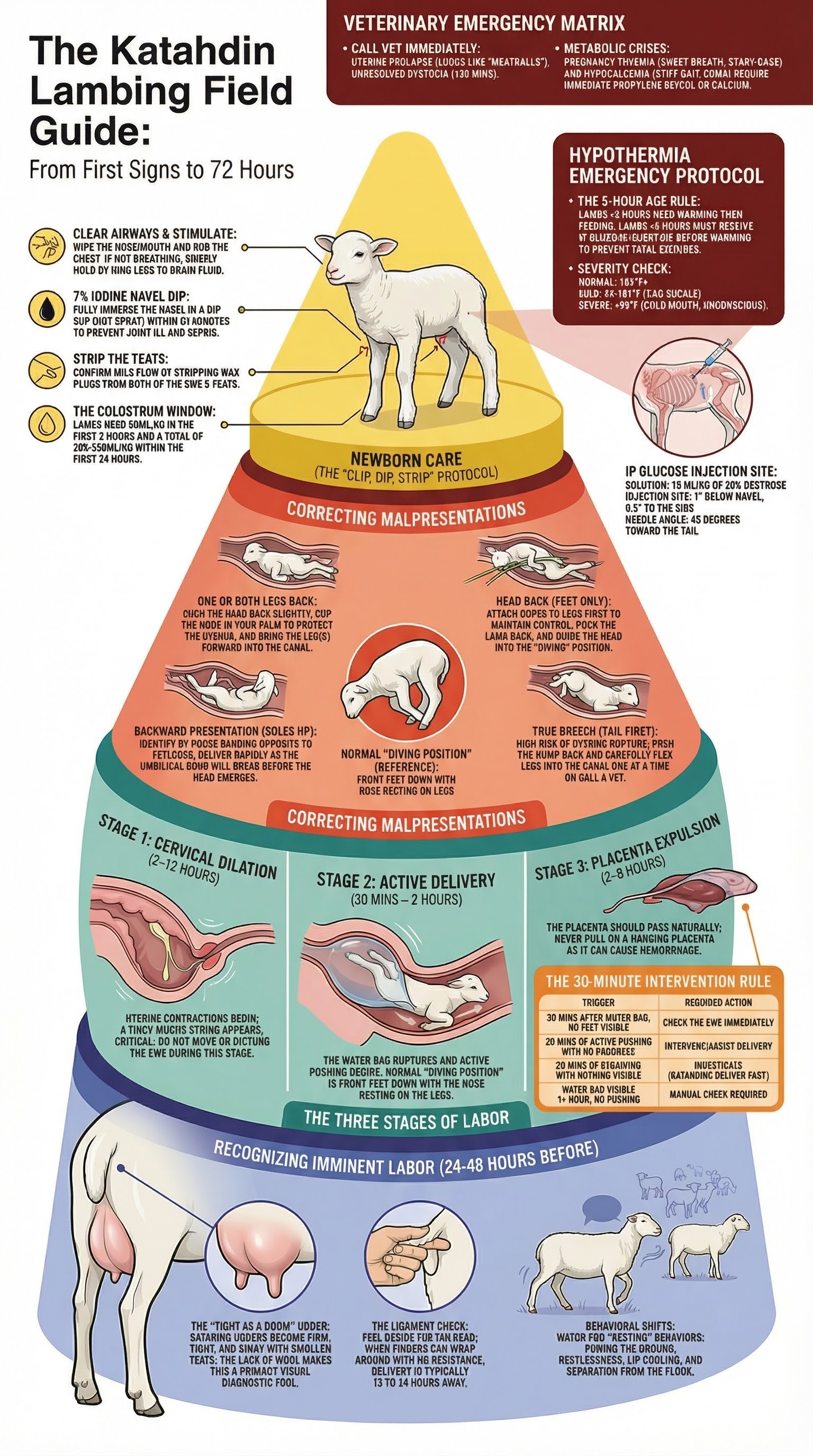
Newborn Lamb Care: The First 72 Hours
Immediately After Birth
The sequence is "clip, dip, strip":
- Clear airways. Wipe the nose and mouth with a clean towel. Rub the chest vigorously to stimulate breathing. If the lamb is not breathing, hold it briefly by the hind legs to drain fluid. Then let the ewe lick and bond.
- Dip the navel. Apply 7% iodine or chlorhexidine 2-4% within 15 to 30 minutes using a dip cup (not a spray bottle - full immersion matters). Re-dip at 12 hours. This prevents navel ill, joint ill, and septicemia.
- Strip the teats. Confirm the ewe has milk in both teats by stripping each one. Remove wax plugs.
Colostrum: The Single Highest Priority
Gut absorption of antibodies is highest in the first hours of life and closes by 12 to 24 hours. There is no second chance at this window.
| Timeline | Target |
|---|---|
| First 1-2 hours | 50 mL per kg of body weight (approximately 6 oz for an 8-pound twin) |
| First 24 hours | 200-250 mL per kg (approximately 24-30 oz for an 8-pound twin), divided across 4+ feedings |
A healthy Katahdin lamb should be on its feet within 10 to 20 minutes and seeking the teat within 30 minutes. If a lamb has not nursed within one hour, intervene with a bottle or tube feeder.
Colostrum source, in order of preference:
- The lamb's own dam (best - contains farm-specific antibodies)
- Another ewe's fresh or frozen colostrum
- Cow or goat colostrum
- Commercial replacer (last resort)
For frozen colostrum: thaw in a warm water bath at 104°F. Never use a microwave - it destroys the antibodies that are the entire point of colostrum.
Use a Brix refractometer to assess quality. A reading of 22% or above is adequate. 26.5% is optimal. Below 22% is poor, and you should supplement or replace.
Tube Feeding
Tube feed when: the lamb is too weak to suck but can swallow, will not latch despite being alert, or is hypothermic but conscious.
Never tube feed: an unconscious lamb, a lamb that cannot swallow, or a severely hypothermic lamb with a cold mouth (warm the lamb first).
The technique:
- Warm colostrum to 104°F
- Measure the tube on the outside of the lamb from the mouth to the last rib - mark the insertion depth
- Insert gently along the left side of the neck - the lamb should swallow it
- Safety check: attach the syringe, pull back the plunger. Strong resistance indicates the stomach (correct). Easy movement indicates the trachea (wrong - remove immediately)
- Deliver slowly. Volume: 50 mL per kg per feeding (approximately 6 oz for an 8-pound lamb)
- For very weak lambs: 50 mL every 2 hours
Warmth Management in Mid-April
Mid-April in the temperate US brings nights in the 30s to 40s°F and days in the 55 to 65°F range. The lower critical temperature for a newborn lamb is 50°F.
Katahdins have an advantage here. Their hair coat repels water, and lambs dry faster than wool-breed lambs. But "faster" does not mean "fast enough" in every situation. A wet newborn in 35°F wind becomes hypothermic within 30 to 60 minutes. The first five hours, while birth fluids dry, represent the highest risk period.
Deep straw bedding (12+ inches) combined with a windbreak may be sufficient for healthy, nursed Katahdin lambs. Have a warming box ready for any lamb that is slow to get going.
Managing Multiples
Every lamb must receive colostrum from the dam in the first two hours. Assist the smallest or weakest to nurse first while the stronger siblings rest.
For triplets, make the decision within hours of birth: keep all three on the ewe (only if she is a proven heavy milker in excellent condition) or remove the smallest for supplemental feeding or fostering. If keeping all three, plan for supplemental bottle feedings three to four times daily and monitor belly fill on all three lambs at every check.
Hold all lambed pairs in a mothering pen (jug) for 12 to 24 hours minimum to establish the bond.
Monitoring Schedule
| Time | Checks |
|---|---|
| 0-1 hour | Clear airways, allow ewe to bond, dip navel, assist nursing if needed, weigh lamb, record birth details |
| 1-2 hours | Confirm first nursing (belly fill check). Strip each teat. Bottle or tube if no nursing. |
| 2-6 hours | Second belly check. Re-dip navel. Check for entropion and contracted tendons. Is the ewe eating and drinking? |
| 6-12 hours | Third belly check. Tube feed if needed. Monitor meconium passage. |
| 12-24 hours | Continue 3-4 hour checks. Total colostrum should reach 200-250 mL per kg. Meconium should have passed. |
| 24-48 hours | Move to mixing pen if bonding is solid. Watch for scours, navel swelling, eye issues. Weigh - the lamb should be gaining. |
| 48-72 hours | Lamb should be thriving: gaining weight, active, nursing confidently. Any lamb still struggling warrants veterinary evaluation. |
Weight Benchmarks
| Birth Type | Expected Birth Weight | Daily Gain Target |
|---|---|---|
| Singles | 9-10 lbs | 0.5-0.75 lb/day |
| Twins | 7-8 lbs | 0.5-0.75 lb/day |
| Triplets | 6-7 lbs | 0.5-0.75 lb/day |
Weight loss exceeding 10% of birth weight in the first 24 hours is a red flag.
Health Checks in the First 24 Hours
Entropion (inverted eyelids): The most common eye problem in newborn lambs. Check every lamb within 24 hours. Signs include excessive tearing and squinting. Mild cases respond to rolling the eyelid outward combined with antibiotic ointment. Moderate cases benefit from a subcutaneous injection of penicillin into the lower eyelid, which creates corrective swelling. Do not retain affected ewe lambs as breeding stock.
Contracted tendons: The lamb walks on its knuckles. Mild cases self-correct within 24 to 48 hours. Moderate cases require splinting with tongue depressors and vet wrap for two to three days.
Cleft palate: Check by feeling the roof of the mouth. A lamb with a cleft palate cannot nurse effectively and is usually not viable.
Hypothermia Protocol
Recognition
| Severity | Temperature | Signs |
|---|---|---|
| Normal | 102-103°F | Alert, active |
| Mild | 99-101°F | Chilled but conscious, shivering, can suckle. Ears cool. |
| Moderate | 95-99°F | Weak, reluctant to stand, cannot suckle. Ears curled. Lethargic. |
| Severe | Below 95°F | Recumbent, cold mouth, no suckle reflex, ears stiff and curled. Emergency. |
The quick field check: put a finger in the lamb's mouth. Warm is acceptable. Cool is mild hypothermia. Cold is severe - act immediately.
The Age Rule
This is the most important decision tree in lambing:
Lambs under 5 hours old still have brown fat energy reserves. Dry them thoroughly, warm them in a warming box to 99°F, tube feed colostrum once warm, and return to the ewe.
Lambs over 5 hours old have depleted their brown fat. They need intraperitoneal glucose before warming. Warming a hypoglycemic lamb without providing energy first causes fatal seizures.
The IP glucose protocol: inject 10 mL per kg of body weight of 20% dextrose solution (mix 2 parts 50% dextrose to 3 parts boiled water). Site: 1 inch below the navel, 0.5 inch to the side. Needle: 20-gauge, 1 to 1.5 inches. Angle toward the tail at 45 degrees. Then warm in a box, tube feed colostrum once revived, and return to the ewe.
Have your vet demonstrate this procedure before lambing season. Practicing it for the first time on a dying lamb at 3 AM is not the approach you want.
Complications and Emergencies
Pregnancy Toxemia (Twin Lamb Disease)
This is the most important metabolic emergency to prevent and the most common reason for late-gestation ewe losses.
| Stage | Signs | Treatment |
|---|---|---|
| Early | Off feed, lagging behind the flock, sweet breath | Propylene glycol, 60 mL orally every 12 hours |
| Moderate | Teeth grinding, star-gazing, tremors, unsteady gait | Propylene glycol + CMPK + vet consult |
| Severe | Unable to rise, blind, seizures | IV dextrose by vet; C-section may be the only option |
Prevention was covered in Part 1. It bears repeating: adequate grain in the last six weeks, body condition score of 3.0 to 3.5 at lambing, and never allowing pregnant ewes to go off feed. Fat ewes (BCS above 4) face the highest risk.
Hypocalcemia (Milk Fever)
Usually appears in late pregnancy or early lactation. The progression: stiff gait, then weakness, then recumbency, then coma.
Treatment: calcium borogluconate 23% administered subcutaneously (50 to 60 mL divided across two injection sites), plus CMPK drench orally. Response is usually rapid, within hours.
The practical approach when you cannot distinguish between pregnancy toxemia and hypocalcemia: treat for both simultaneously. Give subcutaneous calcium plus oral propylene glycol. Rapid improvement after calcium suggests hypocalcemia. Slow or no improvement suggests toxemia, which carries a worse prognosis.
Uterine Prolapse - True Emergency
A large mass with round raised caruncles (the visual description is "meatballs") protruding from the vulva after delivery. Call the vet immediately. This can be fatal within hours.
While waiting:
- Keep the tissue moist with clean damp towels
- Encourage the lamb to nurse (the oxytocin release helps)
- Apply granulated sugar to the tissue to reduce swelling (15 to 20 minutes), rinse, lubricate, and gently reposition if the vet is unavailable
Unlike vaginal prolapse, uterine prolapse has no genetic component. Do not necessarily cull the ewe.
Mastitis
Signs: hot, swollen, firm, or discolored udder half. The ewe walks stiff and will not let the lamb nurse. The milk appears abnormal.
Action: separate the ewe, strip the affected half two to three times daily, administer systemic antibiotics per vet guidance, and provide anti-inflammatory support. Supplement the lambs immediately - their milk supply is compromised and waiting does them no favors.
Rejected or Orphan Lambs
Grafting techniques, listed by success rate:
- Wet grafting - rub birth fluids from the foster ewe's lamb onto the orphan (most effective within one hour of the foster ewe lambing)
- Skin grafting - skin the dead lamb and tie the hide over the orphan for two to three days (approximately 90% success rate)
- Stockinette method - place an orthopedic stockinette on the natural lamb for 24 hours, then turn it inside-out onto the orphan
- Stanchion method - restrain the ewe and allow the orphan to nurse three to four times daily for three to five days
For bottle-fed lambs: use lamb-specific milk replacer only (not calf replacer). Feed 15 to 20% of body weight per day, minimum three feedings. Clean bottles after every feeding. Never reheat leftover formula. Introduce creep feed by one to two weeks of age.
When to Call the Vet
Call Immediately
- Uterine prolapse - a true emergency, potentially fatal within hours
- Dystocia unresolved after 30 minutes of your intervention
- Suspected ringwomb not responding to manual dilation
- Severe pregnancy toxemia - recumbent ewe, unresponsive to oral treatment
- Severe milk fever - unresponsive to two calcium treatments
- Signs of sepsis (high fever, rapid decline, shock)
- Suspected ruptured uterus (ewe suddenly stops straining, becomes quiet and depressed)
Manage On-Farm, but Call if Not Improving
- Mild to moderate pregnancy toxemia responding to propylene glycol
- Hypocalcemia responding to calcium treatment
- Vaginal prolapse with successful retention
- Mild dystocia resolved with repositioning
- Retained placenta in an otherwise healthy ewe
- Mastitis caught early
- Newborn hypothermia responding to warming protocol
The Relationship You Should Already Have
Identify your nearest large-animal vet with emergency availability before lambing season, not during it. Know the approximate cost range for a C-section ($300 to $800+). Find an experienced shepherd or mentor locally who can provide phone or in-person guidance. Establish the relationship with your vet before lambing. Your first call should not be an emergency call.
Night Check Schedule
During active lambing, check ewes every 4 to 6 hours at minimum.
| Time | Action |
|---|---|
| 10-11 PM | Last check before bed |
| 2-3 AM | Middle-of-night check |
| 5-6 AM | Early morning check |
| Daytime | Regular checks throughout |
What to look for: ewes separated from the flock, vulva discharge, tight and shiny udder, pawing or circling, water bag visible, active straining. Separate the "already lambed" group from the "still to lamb" group to make checks faster.
For Katahdins specifically: less intervention is better. If she is not in trouble, do not disturb her. The breed's strong maternal instincts and low dystocia rate are assets, but only if you let them work.
Katahdin-Specific Advantages Worth Knowing
| Advantage | Practical Impact |
|---|---|
| Strong maternal instincts | Rejection is rare. Even yearlings typically display good mothering. Ewes aggressively defend newborns. |
| Low dystocia rate (~5%) | Daily exercise on pasture reduces this further. |
| Clean udders | No wool around teats means lambs find teats faster, which means faster colostrum intake. No crutching required. |
| Vigorous lambs | Born alert, stand and nurse quickly. Hair birth coat aids survival in cold and wet conditions. |
| No tail docking | KHSI breed standards stipulate undocked tails for breeding stock. Less labor, less infection risk. |
| Parasite resistance | Documented resistance to Haemonchus contortus. Even during the periparturient rise, resistant ewes shed fewer eggs. |
Pasture vs. Barn Lambing
Katahdins are well-suited to pasture lambing when predator pressure is managed. The benefits are meaningful: less dystocia from daily exercise, less mis-mothering because ewes distance from the flock to lamb, and better disease prevention from reduced barn density.
The recommended approach for mid-April: a close-in paddock with shelter access (a three-sided shed or run-in). Bring ewes inside only when rain, wind, and cold combine - specifically, wet and windy conditions below 40°F. On calm, dry nights, even in the 30s, healthy Katahdins with lambs over 24 hours old generally do fine outdoors with windbreak access.
What Part 3 Covers
Part 3 of this series covers the cases where the bond between ewe and lamb does not form on its own: recognizing rejection early, the post-dystocia emergency bonding protocol, slime grafting an orphan onto a different ewe, skin-jacket grafting when a ewe lost her own lamb, head-gate forced acceptance, and the full bottle-lamb playbook from colostrum through abomasal-bloat prevention to weaning. Most Katahdin lambings will not need any of it. The minority that do need it cannot wait for you to figure it out at 2 AM.
Series navigation: Part 1: Preparation and Supplies - Part 2 (this post) - Part 3: Rejection and Bottle Lamb Care - Part 4: First-Weeks Procedures - Part 5: First-Year Health - Part 6: NSIP, Growth, and Selection
Download the full field guide slide deck: Lambing Field Guide (PDF)
This article synthesizes research from university extension services (Penn State, Ohio State, NC State, Mississippi State, Oklahoma State, Colorado State, Virginia Tech, Cornell, and others), the Merck Veterinary Manual, NADIS Veterinary Reference, Katahdin Hair Sheep International, the Eastern Alliance for Production Katahdins, and the National Sheep Improvement Program. It is intended as educational reference - always consult your veterinarian for medical decisions specific to your flock.