Katahdin Lambing Part 3: Rejection and Bottle Lamb Care
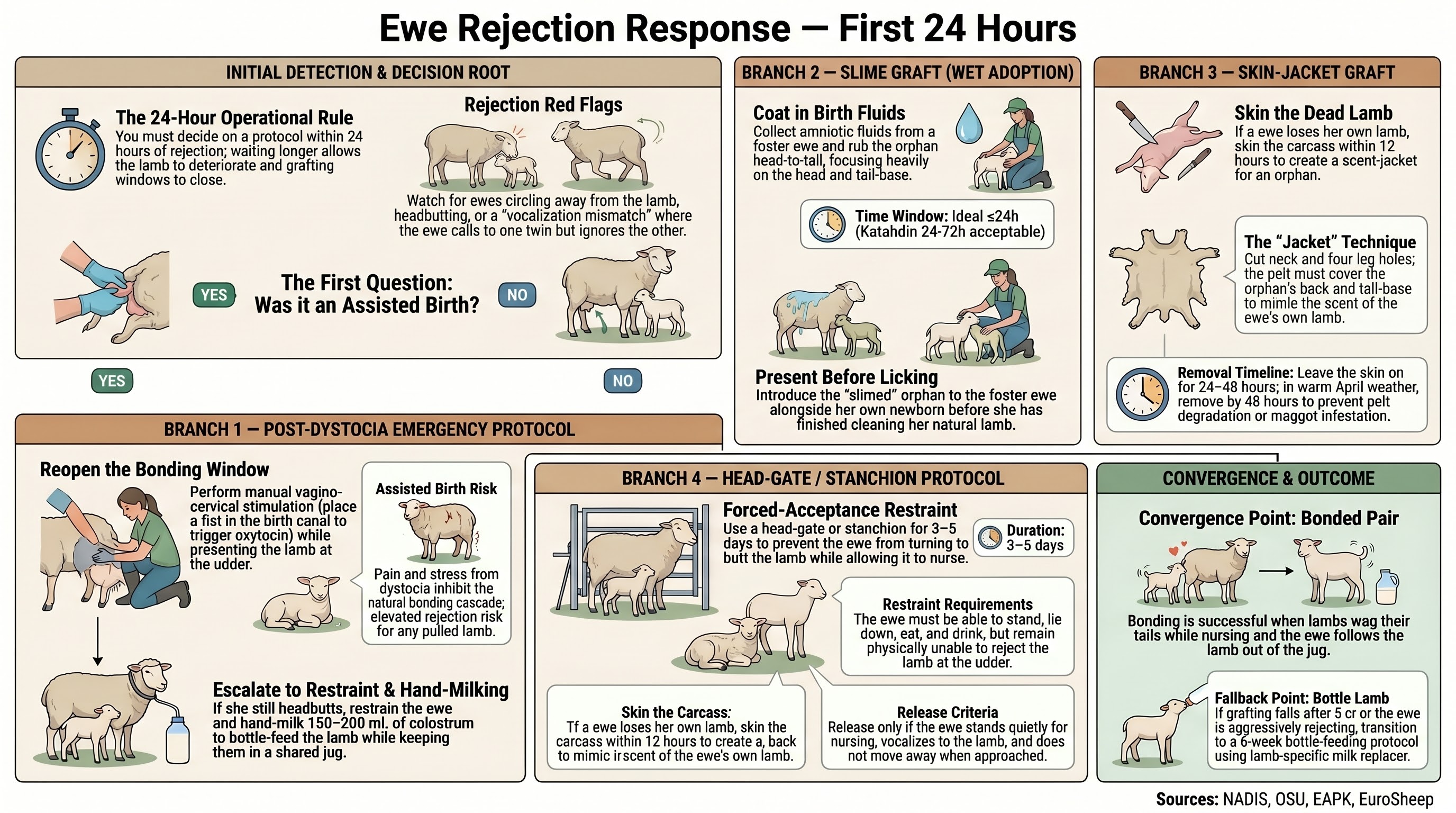
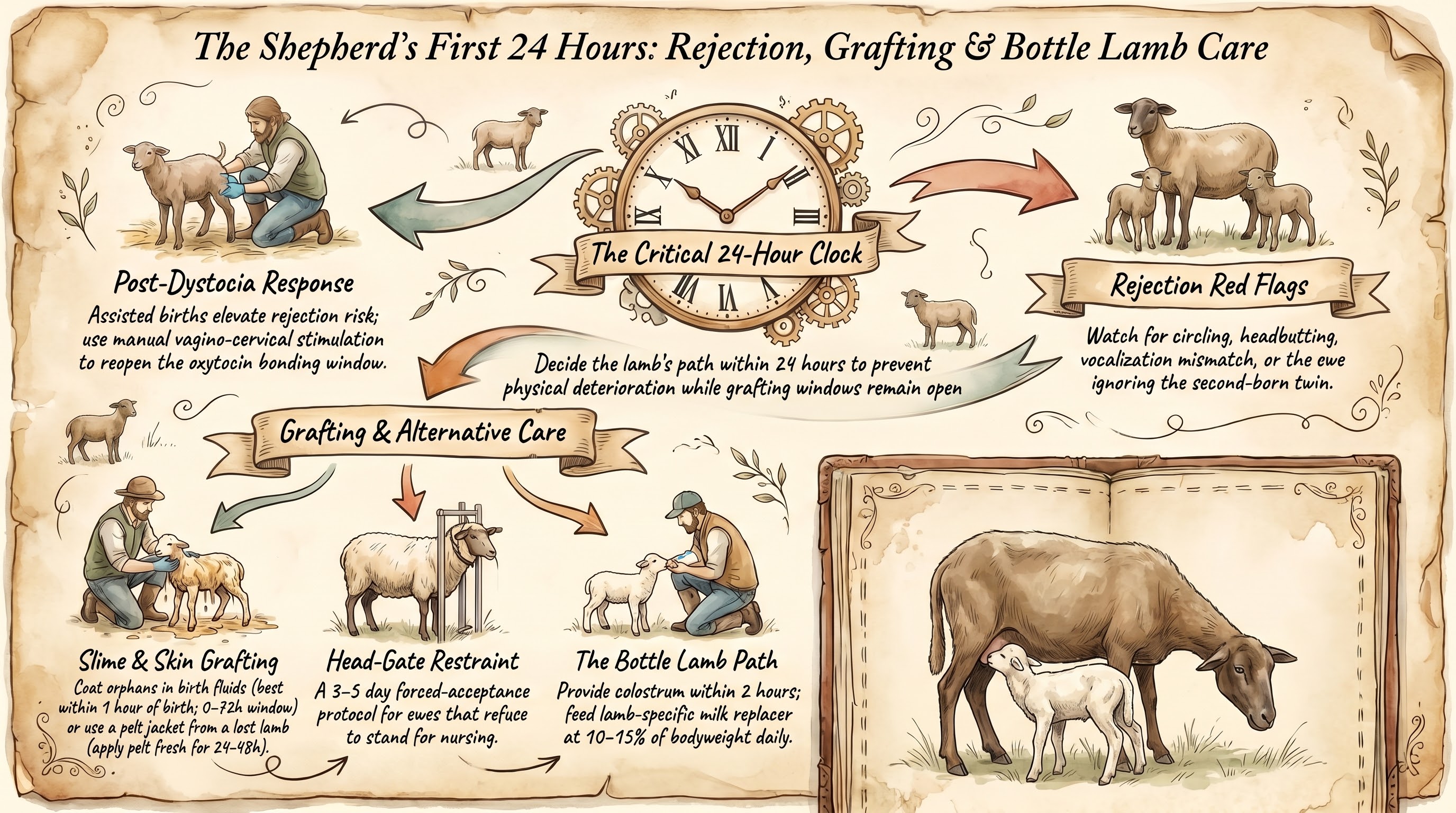
Decide within 24 hours of a rejection event. Indecision runs down both clocks at once - the graft window closes and the lamb deteriorates. That single rule should organize everything you do once a ewe turns away from her own lamb.
Part 1 covered preparation: nutrition, supplies, facilities, and the calendar. Part 2 covered the labor itself and the first 72 hours. This article covers what you do when the bond does not form on its own - recognizing rejection early, intervening before it hardens into refusal, grafting an orphan onto a different ewe, and managing a bottle lamb when no graft is available. Katahdins are reputed as good mothers, and the breed earns that reputation in most lambings. But "rare" is not "never," and rejection happens most often in the situations Part 1 told you to expect: first-time mothers, pulled lambs, and the weakest of a set of multiples.
The First-Hour Bonding Window
Maternal bonding in sheep is not gradual. It runs on a hormonal window that opens during birth and closes within hours. Vaginal-cervical stimulation during delivery, plus the smell of amniotic fluid, plus the act of licking the lamb together imprint the lamb's odor on the ewe. Disrupt that sequence and the imprint may not take.
The peer-reviewed framing from the NIH-hosted lambing-management review is unambiguous: bonding generally occurs in the first hour after birth, and the ewe must have an undisturbed opportunity to bond. Failure to bond and failure to find the teat are major risk factors for hypothermia, hypoglycemia, and septicemia. Everything that follows in this article is an attempt to either protect that first hour or rebuild what it should have done.
Your job in the first hour is to observe, not to intervene. If the ewe is cleaning the lamb and the lamb is nursing, stay out. Check at 30 minutes, 60 minutes, 2 hours, and 4 hours - not more often if the picture is normal. The Ohio State Small Ruminant Team's tail-wag sign is the quick read for normal: healthy lambs stretch when they get up and wag their tails while nursing. Both signs together mean the bond is forming and the lamb is getting milk.
Recognizing Rejection Early
Active rejection looks different from a slow start. Treat any of these as a red flag and intervene immediately:
| Behavior | What it means |
|---|---|
| Ewe circles away when the lamb approaches the teat | Active rejection. NADIS classifies this as abnormal and grounds for intervention. |
| Headbutts or horn-pushes the lamb | Active rejection with injury risk. |
| Calls to one lamb but not the other | Partial twin-rejection. The unanswered lamb will starve. |
| Does not clean the lamb or eat the placenta | Bonding cascade disrupted. |
| Accepts the firstborn of twins but not the second | Classic twin-rejection - the most common pattern. |
| Ignores the lamb while attending to her own feet or feed | Low maternal drive, common in primiparous ewes. |
The risk profiles are predictable. First-time mothers are more prone to mismothering and require greater surveillance. Post-dystocia ewes - anything you pulled, repositioned, or sectioned - face elevated rejection risk because the bonding cascade was interrupted by pain and human handling. Twin and triplet ewes shove the smaller lambs aside more often than singles. And any ewe disturbed by barn activity, weather, or a stray dog during the first hour may fail to imprint.
Why Rejection Happens
The behavioral mechanism is the same in every case: the imprint did not take, or it took on the wrong cues. The contributing causes are worth knowing because they are mostly preventable through choices Part 1 covered.
Primiparous ewes are the largest single category. A first-time mother has no template. Combined with a difficult birth, she may treat the lamb as an irritant rather than offspring. Selecting replacement ewes from dams with strong mothering history compounds in your favor over a few generations.
Dystocia and assisted births disrupt the hormonal window directly. The vaginal-cervical stimulation that triggers oxytocin release was either bypassed (cesarean) or paired with pain and human handling (manual extraction). Even a textbook pull can shift the balance.
Multiples outrun the ewe's capacity to imprint on every lamb in the same window. A ewe focused on cleaning the firstborn may not turn back to a second lamb that arrives 30 minutes later, especially if the second is smaller or weaker.
Scent disruption occurs when something interferes with the smell signal. Excessive human handling in the first hour, washing the lamb, or moving the ewe to a different jug while she is still in early bonding can all blunt the imprint.
Pain and illness suppress maternal behavior. Mastitis, pregnancy toxemia, hypocalcemia, and severe dystocia recovery all push the ewe's attention inward. Udder pain in particular makes nursing aversive - a lamb's nudge feels like an attack, and the ewe steps away.
Body condition extremes at lambing matter. A ewe at body condition score 2.0 or below may lack the metabolic reserve to mother actively. A ewe above 4.5 may be subclinically toxemic and behaviorally flat.
Prevention
Prevention is mostly a Part 1 problem. The pre-lambing actions that minimize rejection are the same ones that prevent toxemia and dystocia: target body condition score 3.0 to 3.5 at lambing, full CDT vaccination, adequate selenium and vitamin E, hooves trimmed, daily exercise on pasture. Add three lambing-specific habits:
- Set the jug up before she needs it, but do not move her into it during early labor. Cervical complications and disrupted bonding both follow from premature jug confinement.
- Minimize human presence during the first hour after birth. Dip the navel, confirm nursing, then back off. Tail-base sniffing and licking are how the ewe encodes the imprint, and your presence near the lamb interferes with that.
- Strip the teats before the lamb arrives or in the first minutes after. A wax plug is a real cause of "the ewe will not let her nurse" that gets misread as rejection. Confirm milk flow on both sides.
For first-time mothers specifically, plan extra surveillance for the first six hours. They are not bad mothers by default, but they are the segment most likely to need a nudge.
Post-Dystocia Emergency Bonding
If you pulled a lamb, corrected a malpresentation, or ended in a cesarean, treat rejection as the default outcome until bonding is confirmed. Do not wait to see if it settles.
Stay in the jug for 30 to 60 minutes of uninterrupted observation after delivery. The Ohio State Small Ruminant Team's protocol for reopening the bonding window is the single most useful technique in this whole article: place a clean, lubricated hand in the ewe's birth canal and make a fist. She should begin to strain as if delivering another lamb. That straining triggers oxytocin release and reopens maternal imprinting after birth is complete. Hold for 30 to 60 seconds and release.
Present the lamb at the udder during the stimulation. The ewe should lick the lamb and stand for nursing within minutes. If she does, monitor every 30 minutes for four hours and continue normal jug protocol.
If she rejects actively despite stimulation - circling away, headbutting - restrain her in the jug with a head-gate, tie-up, or halter clipped to a panel, and hand-milk 150 to 200 mL of colostrum. Deliver it to the lamb by bottle if it has a suckle reflex, or by stomach tube if it does not (Part 2 covered the technique). Re-present at the udder every three to four hours with the ewe restrained.
Never leave a weak post-dystocia lamb overnight with a rejecting ewe. By morning the lamb will be hypothermic and hypoglycemic, and you will have lost the easier choice. If the bond is not forming by 24 hours, reclassify as a bottle lamb and move the ewe out of the jug.
Slime Grafting - The Highest-Success Method
When another ewe on the farm is lambing now, or has just finished, slime grafting is the technique with the strongest cited success record. NADIS calls rubbing an orphan in the foetal fluids of the foster ewe's newborn before she licks her own lamb the most successful fostering method, and notes that it works only in the period immediately after lambing.
The window:
- Best: orphan under 24 hours old, foster ewe actively lambing or just finished.
- Still works: orphan up to 24 to 72 hours old, with patience. The Eastern Alliance for Production Katahdins reports success at this age range with an extra effort.
- Closed: foster ewe lambed more than 24 hours ago and has already cleaned and bonded with her own lamb. Switch to skin-jacket grafting (next section) or head-gate forced acceptance.
Technique:
- Catch the birth fluids. A clean bucket, towel, or plastic sheet under the foster's hindquarters captures amniotic and allantoic fluid as she lambs.
- Coat the orphan head to tail. The head and the tail-base matter most. Ewes sniff the tail before accepting, so the tail-base must carry the foster's scent.
- Present the orphan alongside the foster's own newborn before she finishes licking. She should start licking both lambs together.
- If the foster has already finished cleaning her own lamb, use the vagino-cervical stimulation technique from the post-dystocia protocol to reopen the window, then present the slimed orphan.
Watch for success: the ewe licks the orphan, the orphan nurses, the ewe sniffs both lambs without aggression. Watch for failure: the ewe accepts her own but pushes the orphan away. If she splits the difference, escalate to the head-gate.
Skin-Jacket Grafting - When a Ewe Lost Her Own Lamb
If a ewe's lamb was stillborn or died in the first day, and an orphan needs a mother, the skin-jacket method exploits the same scent mechanism as slime grafting. Ewes identify their lambs by tail-base odor. Wear the dead lamb's skin on the orphan and the orphan carries the scent the ewe expects.
The protocol, drawing on the EuroSheep Network and Ohio State guidance:
- Skin the dead lamb within 12 hours of death. Pelts degrade fast in spring temperatures. Cut a neck hole and four leg holes. Tie under the belly if loose.
- Cover the back and tail-base thoroughly. This is where the ewe sniffs.
- Introduce the orphan to the ewe in a lambing jug. She should sniff the tail and begin licking and vocalizing.
- Leave the skin on at least 24 hours. EuroSheep treats 24 hours as the standard floor. Ohio State allows up to "a few days." In a Virginia spring, plan to remove by 48 hours before pelt degradation and fly-strike risk climb.
- Confirm bonding before removal. The ewe should vocalize to the orphan, stand quietly for nursing, and not move away on approach.
If you cannot or will not skin the dead lamb, the textile-coat alternative is supported by the Alexander and Stevens 1985 study in Applied Animal Behaviour Science: put a sock or fabric tube on the dead lamb for 24 hours to absorb odor in situ, then transfer that fabric to the orphan before presenting. Less reliable than real skin but cleaner and usable when the pelt is damaged.
Head-Gate Forced Acceptance
When slime and skin grafts are not viable - wrong timing, no foster scenario - the head-gate or stanchion method forces proximity until the ewe stops resisting. It is also the fallback when a ewe is rejecting her own lamb without another ewe available to take over.
Set up a head-gate or stanchion that holds the ewe's head forward so she cannot turn and butt the lamb. A scaled-down cattle head-gate works. So does a homemade 2x4 frame with a slide-lock. The ewe must be able to stand, lie down, eat, and drink. She must not be able to turn sideways or back up. Water and hay within reach of her head-gated position. The lamb roams freely in the jug and nurses at will.
The Ohio State protocol holds the ewe in the stanchion for three to five days. Check twice daily for bonding signs. Extend to five to seven days if aggression persists. Release when all three of these are true:
- The ewe stands quietly when the lamb approaches her udder.
- The ewe sniffs and vocalizes to the lamb - actively engaging, not just tolerating.
- The ewe does not move away when the lamb approaches after release from the head-gate.
Set expectations honestly. NADIS reports that long-term acceptance rates from head-gate grafting may be less than 60 percent. EAPK is more conservative for Katahdins specifically: about 20 percent of foster ewes accept the alien lamb either begrudgingly or without question through head-gating alone, with their highest success coming from slime grafting paired with head-gating. Plan for failure. Have a bottle-lamb plan ready before you start the protocol, because roughly 40 percent of head-gate grafts will need to convert.
Scent-Masking Myths
Skip the Vicks VapoRub on the ewe's nose, the molasses water, the perfume, and the vanilla extract. These persist in homesteading lore and they failed in controlled trials. Alexander and Stevens concluded in 1985 that the practice of using odoriferous substances to mask lamb odor is not soundly based.
What works is the transfer of the foster ewe's own scent - birth fluids in slime grafting, the dead lamb's skin in pelt grafting, or the textile-coat method that absorbs the foster's own lamb's odor. The mechanism is real. The shortcut around it is not.
Bottle-Lamb Protocol
Bottle lambs become the plan when graft methods fail, no foster scenario exists, or the ewe's health precludes nursing - severe mastitis, post-cesarean debilitation, death of the dam.
Colostrum in the First 24 Hours
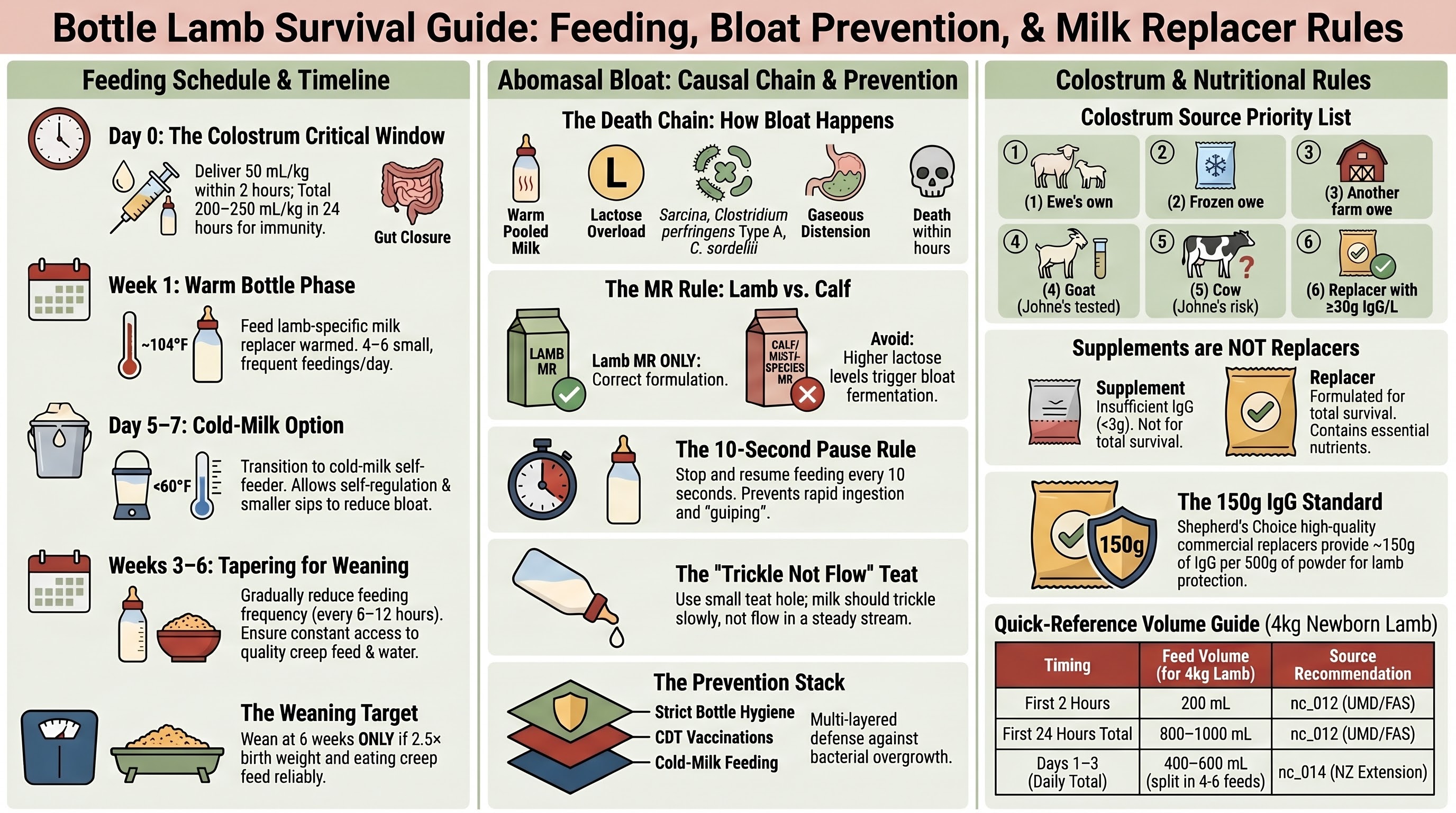
Gut absorption of immunoglobulins closes by 12 to 24 hours. There is no second window. Sources in priority order:
- The lamb's own dam, hand-milked, 150 to 200 mL per feed.
- Frozen ewe colostrum thawed in a warm water bath at 104°F. Never microwave - it denatures the IgG that is the entire point of the colostrum.
- Another ewe on the farm who freshened in the last 24 hours.
- Goat colostrum from a Johne's-tested source. The fat profile matches sheep better than cow colostrum.
- Cow colostrum, with the Johne's-disease caveat the University of Maryland flags. Larger volume needed because of lower fat content.
- Commercial colostrum replacer - not supplement - at 30 g IgG per liter or higher. FAS Scotland's guidance is the standard. Penn State Extension is explicit that colostrum supplements alone do not reach the IgG concentration required for complete passive transfer of immunity.
Volume targets:
| Time | Volume |
|---|---|
| First 2 hours | 50 mL per kg of body weight |
| First 24 hours total | 200 to 250 mL per kg, divided across at least four feedings |
A 4 kg Katahdin newborn needs 200 mL in the first two hours and 800 to 1000 mL by 24 hours. Premier 1's Shepherd's Choice replacer is one well-documented commercial option, with 150 g of IgG per 500 g packet.
Milk Replacer After Day 1
Use lamb-specific milk replacer only. The University of Maryland Extension is unambiguous: do not feed calf or multi-species milk replacer to lambs or kids. The higher lactose drives abomasal bloat. Lamb MR specs run 24 to 30 percent fat with low lactose, mixed exactly per label.
Temperature: about 104°F for bottle feeding (body temperature). Below 60°F if the lamb is on a cold-milk free-choice self-feeder after day five to seven. Never feed warm milk free-choice. Lambs overeat warm milk and bloat. Cold milk self-regulates.
Feeding Schedule
The 10 to 15 percent of body weight per day rule is the spine of the schedule, with up to 20 percent for small lambs in cold weather. A 4 kg lamb gets 400 to 600 mL per day.
| Age | Feeds per day | Volume per feed (4 kg lamb) | Notes |
|---|---|---|---|
| Days 1 to 3 | 4 to 6 | 80 to 120 mL | Small, frequent. Body temp. |
| Days 4 to 7 | 4 | About 150 mL | Cold self-feeder can be introduced. |
| Days 8 to 21 | Every 6 hours | About 375 mL | Or transition to cold free-choice. |
| Days 21 to 35 | Every 8 to 12 hours | Decreasing | Creep feed available. |
| Day 30 plus | Off milk | - | Wean once targets are met. |
Target weaning is six weeks. The University of Maryland's three-criteria test is the right gate: at least 30 days old, 2.5 times birth weight, and eating creep feed and hay reliably. A 4 kg lamb at birth weans at roughly 10 kg.
Abomasal Bloat - The Number One Bottle-Lamb Killer
Abomasal bloat kills bottle lambs at two to four weeks of age. The mechanism: pooled warm milk in the abomasum ferments under Sarcina ventriculi, Clostridium perfringens type A, and Clostridium sordellii - the last cultured from 20 percent of cases in the cited PubMed series. Sudden gaseous distension, colic posture, death within hours.
The risk factors stack: calf MR fed instead of lamb MR, large infrequent meals (twice-daily warm milk is the worst), rapid ingestion through a teat hole that flows rather than trickles, poor bottle hygiene that seeds the abomasum with bacteria. The Maryland Small Ruminant Page documents that the highest incidence is in lambs and kids fed warm milk infrequently.
The prevention stack is non-negotiable:
- Lamb MR only. Calf MR's lactose drives the fermentation.
- Small, frequent feeds. Four to six per day in week one. Never large twice-daily meals.
- The 10-second pause rule. Stop and resume feeding every 10 seconds. This is from the Maryland Small Ruminant Page directly.
- Small teat hole. When you tip the bottle upside down, the milk should trickle, not flow. Beef + Lamb New Zealand's artificial-rearing factsheet drives this point.
- Cold-milk self-feeder after day five to seven. Cold milk self-regulates intake.
- CDT vaccination on schedule. The clostridial vaccine reduces - though does not eliminate - Type A and similar risk.
- Strict bottle hygiene. Clean the nipple after every feed.
Other bottle-lamb pathologies worth knowing:
| Pathology | Sign | Action |
|---|---|---|
| Overfeeding scours | Yellow pasty manure | Dilute MR, increase frequency. |
| Hypoglycemia, floppy lamb | Limp, cannot stand, cold | Warm plus Karo syrup sublingually. Per vet, IV dextrose. |
| Navel ill (omphalitis) | Swollen wet navel, fever | Skipped iodine dip at birth. Treat per vet - penicillin. |
| Watery mouth (E. coli) | Drooling, depressed, under 12 hours old | Failure of colostrum transfer. Vet call, IV fluids. |
Welfare - Never a Lamb Alone
A bottle lamb alone in a pen develops behavioral problems and grows poorly. Pair with another bottle lamb or, at minimum, keep within sight and sound of the flock. This is not sentiment - it is welfare science with a productivity cost attached.
Jug Management and Release
A lambing jug is a tool for protecting the bond, not a holding pen. Longer is not better. Virginia Tech's extension guidance is that ewes and lambs should leave the jug as quickly as possible because pneumonia and diarrhea risk both climb with confinement time.
Duration by scenario:
| Scenario | Jug duration |
|---|---|
| Strong, healthy single | 24 to 36 hours |
| Twins | 48 hours |
| Triplets or weak lambs | 3 plus days |
| Rejected lamb plus grafted ewe | 3 to 5 days, head-gate protocol |
| First-time ewe with normal birth | 48 hours, conservative |
Release signals - all four must be true:
- Lambs wag their tails while nursing.
- Lambs stretch when getting up.
- The ewe stands calmly for nursing.
- The ewe vocalizes to and follows her lambs.
Strip the bedding between pairs and disinfect water and feed tubs. The disease targets are the ones that hit hardest in close confinement: Clostridium perfringens causing sudden death in lambs, navel ill, and orf. After the jug, move the pair to a mixing pen with three or four other ewe-lamb pairs for 24 to 48 hours. Watch for misclaiming - a ewe who attaches to the wrong lamb - and stealing - a dominant lamb nursing from the wrong ewe and depriving that ewe's own lamb. Then release to the flock.
The escalation rule: if a lamb is thin-flanked or the ewe turns away at every check at 24 hours in the jug, pivot to a graft attempt or bottle conversion. Do not leave the family hoping it resolves.
Decision Framework
A small operation does not have unlimited time, foster opportunities, or tolerance for protracted intervention. The literature supports a tiered decision framework with a 24-hour timebox.
| Hour | Action |
|---|---|
| 0 | Rejection observed. Attempt initial bonding (vagino-cervical stimulation, present lamb at udder). |
| 1 | If no bond, assess: foster ewe available? Dead-lamb scenario? |
| 1 to 4 | Slime graft, skin-jacket graft, or head-gate setup. |
| 4 to 24 | Execute the chosen protocol. Tube-feed colostrum if the lamb is not nursing. |
| 24 | Decision point - bonded, or convert to bottle lamb. |
Method tiering, by cited evidence rather than fabricated rates:
- Tier 1, highest success: slime graft when the foster window is open. NADIS describes this as the most successful fostering method.
- Tier 2, high success: slime plus head-gate combined. EAPK reports their greatest success from this combination. Skin-jacket graft when a ewe lost her own lamb within 12 hours.
- Tier 3, moderate success: head-gate alone. NADIS reports under 60 percent long-term acceptance. EAPK reports about 20 percent for Katahdins.
- Fallback, always works at high labor cost: bottle lamb. About six weeks of labor. About $50 to $80 per lamb in milk replacer and colostrum replacer. Watch for abomasal bloat throughout.
The honest cost picture for a bottle lamb on a small operation:
- Materials: $50 to $80 for six weeks (lamb MR plus colostrum replacer).
- Labor weeks one through three: about 15 minutes per feed times four feeds per day, or about 60 minutes a day.
- Labor weeks four through six: two feeds per day, or a cold self-feeder, about 15 minutes a day.
- Total over six weeks: 35 to 40 hours.
That is a real number. On a 20-ewe operation with a 5 percent rejection rate, you should plan to bottle one lamb a year on average and not be surprised when it happens.
When Euthanasia Is the Right Call
Welfare triage matters. Ohio State frames the gate plainly: an alien lamb must be able to stand and move about for any graft to be successful. A lamb that is down needs immediate intensive care. If the intensive care is not working, prolonging suffering is not kindness.
Euthanasia is welfare-appropriate when:
- The lamb cannot stand after warming and tube feeding.
- The lamb cannot nurse despite presentation at the udder or bottle.
- Hypothermia persists despite active warming.
- A severe congenital defect is present - cleft palate, bilateral entropion, severe atresia ani.
Call the livestock vet for confirmation and humane method. A captive bolt or firearm under the vet's written guidance is the accepted on-farm humane technique for neonatal lambs. This is the part of the job nobody wants to learn, and the year you need it you will be glad you learned it before.
Records - What to Capture for Next Season
Every rejection event is a data point about your flock. Log it. Over a few seasons, the pattern that emerges from your own ewes is more useful than any published rate, because it is tied to your genetics, your facility, and your management.
For each event, record:
- Date and ewe tag, with parity (first lamb, second lamb, third plus).
- Lambing time and whether the birth required assistance.
- Lamb tags including the rejected lamb.
- Red flags observed - circling, headbutting, vocal mismatch, ignoring.
- Intervention attempted - vagino-cervical stimulation, slime graft, skin-jacket graft, head-gate, bottle conversion.
- Outcome: accepted, partial, failed.
- Time to bonding confirmation.
- Bottle-lamb start and weaning dates if applicable.
Two seasons of records will tell you whether a specific ewe is a chronic rejecter - cull tag her - or whether you have a pattern tied to first-time mothers that better surveillance can fix.
When to Call the Vet
Some situations are not on-farm calls. Have your large-animal vet's number and your nearest extension sheep specialist's number in the lambing kit. Call when:
- A ewe shows suspected mastitis - hot, hard, asymmetric udder. Mastitis may be the rejection cause.
- A retained placenta exceeds 24 hours, or uterine prolapse occurs (Part 2 covered this as a true emergency).
- A lamb cannot stand after warming and tube feeding.
- A lamb under 12 hours old shows watery-mouth signs - drooling, depression - pointing at E. coli septicemia from failed passive transfer.
- A lamb over 24 hours has not received colostrum. Plasma transfusion may be indicated.
- Sudden abdominal distension with colic posture appears in a bottle lamb. Abomasal bloat is an emergency that may require trocarization.
What Success Looks Like on a Small Katahdin Operation
A 20-ewe Katahdin flock managed through a typical mid-Atlantic spring will see most ewes lamb and bond without your direct involvement. The breed earns its reputation through a low dystocia rate, clean udders that lambs find quickly, and strong maternal instincts that defend lambs aggressively. The work in this article is for the minority of cases where that default does not hold.
A successful season with rejection events handled well looks like this. Two or three first-time mothers required closer surveillance and one needed a vagino-cervical-stimulation intervention to seal the bond after a pulled lamb. One ewe of the older group rejected her second twin; you slime-grafted that lamb onto a different ewe lambing the same morning, and both lambs grew on schedule. One lamb went to a bottle because its dam died of complications you could not have prevented. Six weeks later that lamb weaned at 22 pounds and joined the flock without behavioral issues because it lived alongside another lamb the whole time.
The instinct to feel like a failed shepherd when a ewe rejects her lamb is widespread and unhelpful. Rejection is a known event in sheep production at every scale. The shepherd's job is not to prevent every rejection - many of them are not preventable - but to recognize them early, intervene with the highest-success method available, and make a clean decision within 24 hours when a graft is not going to take. That is the standard. Run to it and you will close most seasons with healthy lambs and a flock you trust to do its own work most of the time.
Parts 1, 2, and 3 cover the lambing event itself. Part 1 was the preparation that determines whether you have a chance. Part 2 was the labor and the first 72 hours where preparation either pays off or reveals its gaps. Part 3 was the response to the cases where the bond does not form on its own. The series continues forward into the rest of the lamb's first year - Part 4, Part 5, and Part 6 cover first-weeks procedures, first-year health, and NSIP-anchored growth and selection through the yearling milestone. Keep the printouts in the barn. Add to them every season.
What Part 4 Covers
Part 4 of this series picks up where the lamb is on the ground and the bond is solid, and walks through the first-weeks procedural stack: castration architecture and pain management, USDA scrapie-program identification, KHSI tagging conventions, and ear-tag mechanics. Most of the work in Part 4 happens in the first month of life and sets the regulatory and selection-pipeline groundwork for everything that follows.
Series navigation: Part 1: Preparation and Supplies - Part 2: Delivery and Complications - Part 3 (this post) - Part 4: First-Weeks Procedures - Part 5: First-Year Health - Part 6: NSIP, Growth, and Selection
Download the full rejection-protocols slide deck: Rejection, Grafting, and Bottle-Lamb Care (PDF)
This article synthesizes research from university extension services (Penn State, Ohio State, University of Maryland, Virginia Tech, and others), peer-reviewed sources (PMC/NIH lambing-management review, Alexander & Stevens 1985 in Applied Animal Behaviour Science, PubMed reports on abomasal-bloat pathogens), the Merck Veterinary Manual, NADIS Veterinary Reference, EuroSheep Network, FAS Scotland, Beef + Lamb New Zealand, the Maryland Small Ruminant Page, the Eastern Alliance for Production Katahdins, Premier 1 Supplies, and Katahdin Hair Sheep International. It is intended as educational reference: always consult your veterinarian for medical decisions specific to your flock.