Katahdin Creep Feeding and Lamb Nutrition
Creep feeding gets framed as a way to push weaning weights up. That framing is half-right and badly misleading. The first reason to put creep in front of two-week-old lambs is to start the rumen, not to add pounds. The pounds come later, in a window that closes faster than most small-flock operations realize, and the economics turn from generous to brutal somewhere around six months of age. If the creep program is built for finishing instead of for rumen development and early-life feed conversion, the math on a 20-ewe Katahdin flock stops working.
This article picks up where the lambing series leaves off and zooms in on a single question: how do you feed Katahdin lambs and their dams from birth through weaning so the pounds the ewes are producing show up on the scale, the rumen develops cleanly, the coccidiostat in the feed is one of the two FDA-approved sheep options and not a cattle product that will kill them, and the replacement ewe lambs do not get fat in their developing mammary gland? Most of the failure modes are nutritional or regulatory rather than infectious, and most of them are preventable on paper if you read the labels and run the numbers.
The flock context is the same as the lambing series: a 20-ewe Katahdin operation in Cumberland County, Virginia, on improved pasture with limited barn confinement. The protocols are calibrated to that scale and that climate, and they are built around the body of extension and primary literature listed at the end of the post. The frame is not "feed more" or "feed less" - it is "feed the right thing in the right window."
Creep Is a Rumen-Development Trigger
A newborn lamb has a non-functional rumen. Milk bypasses it through the esophageal groove and enters the abomasum directly. The rumen develops in response to mechanical scratch, butyrate stimulation from microbial fermentation, and the gradual establishment of a microbial population that can ferment forage and grain. Penn State Extension's creep feeding write-up is direct about the biology: the early creep window is not about intake, it is about training the lamb to eat solid feed and habituating the rumen to the substrate it will need to ferment.
The practical consequence is that creep should be in front of lambs by 10 to 14 days of age even though meaningful intake will not start until three to four weeks. Across the first 28 days of life, total creep intake is around one pound per lamb. That is trivial as a feed cost and trivial as a pound-of-gain input. It is decisive as rumen training. Skip the early window and the rumen-development arc compresses into a shorter ramp later, with worse feed conversion and higher digestive-upset risk when the lamb finally engages with the feeder.
The intake then ramps. By day 20 lambs are eating roughly 0.5 lb per head per day. The peak feed conversion window runs from about day 28 to day 120, with conversion ratios of two to four pounds of feed per pound of gain. That conversion window is the entire economic case for creep. After six to seven months of age, conversion drops to six to eight pounds of feed per pound of gain, and the math on grain finishing turns negative quickly. The asymmetry is not subtle: an eight-week-old lamb is roughly twice as efficient at turning feed into pounds as a six-month-old lamb. If the goal is pounds at weaning, the place to spend feed dollars is early.
What Goes In the Feeder
Creep ration design has two simple targets and several non-negotiable sheep-specific constraints. The protein target moves through the lamb's life:
| Phase | Crude protein | Base mix | Notes |
|---|---|---|---|
| Starter (day 10 through ~6 weeks) | 18 to 20 percent | 80 to 85 percent ground or cracked corn, 15 to 20 percent soybean meal, free-choice alfalfa | Grain MUST be ground or cracked so lambs cannot sort it |
| Grower (6 weeks through weaning) | 14 to 16 percent | 90 percent corn, 10 percent soybean meal, ~12.5 percent CP, supplemented with alfalfa for protein lift | Protein source must be all-natural, no urea or NPN |
The Penn State and Maryland Small Ruminant Page guidance partially disagrees on the starter floor. Penn State pushes 18 to 20 percent CP for the first phase. Maryland Small Ruminant Page reports a broader 14 to 18 percent floor with all-natural protein required either way. The conservative synthesis is 18 to 20 percent CP for the first 30 to 45 days, dropping to 14 to 16 percent by weaning, and never urea-based non-protein nitrogen. Young-lamb urea tolerance is poor and the failure mode is acute.
Substitution rules are simple. Sorghum substitutes for corn one for one. Oats replace corn at 1.25 times the corn rate to match energy density. Soybean meal is the default protein, with cottonseed meal as a substitute at the same rate. Mixing the grain and protein rather than feeding them separately matters because lambs will sort and the resulting mineral and protein profile will not be what the formulation is supposed to deliver.
The Sheep Mineral Rule Is Non-Negotiable
The single highest-leverage decision in a creep program is using sheep-specific mineral and not cattle, horse, goat, or poultry mineral. Sheep are uniquely sensitive to copper. NRC 2007 puts the maximum tolerable dietary copper at roughly 15 ppm dry matter, with a requirement of about 5 ppm and toxicity rising sharply above 25 ppm. Cattle and horse mineral premixes routinely run 30 to 80 ppm copper because cattle and horses tolerate it. Feeding cattle mineral to sheep does not trigger acute toxicity on day one. It builds copper in the liver across weeks to months. The hemolytic crisis arrives without much warning when a stressor releases the stored copper into circulation, and the case-fatality rate is high.
| Mineral or ratio | Target | Failure mode | Source |
|---|---|---|---|
| Calcium to phosphorus ratio | 2:1 or higher | Urinary calculi in ram and wether lambs | Penn State Extension |
| Copper | 5 ppm requirement, 15 ppm maximum tolerable, toxic above 25 ppm | Chronic copper toxicity, hemolytic crisis | NRC 2007 |
| Selenium | 0.10 to 0.30 ppm DM total diet | White muscle disease in 2-to-6-week lambs, often fatal cardiac form | NRC 2007, Virginia Cooperative Extension |
| Molybdenum and sulfur | Mo 1 to 2 ppm, S 0.15 to 0.25 percent | Low Mo amplifies Cu toxicity | NRC 2007 |
| Ammonium chloride (optional) | 0.5 percent of total diet | Additional urinary calculi insurance | Penn State Extension |
Selenium is a regional problem. The mid-Atlantic, including Virginia, sits on selenium-marginal soils. The dam carries the selenium budget into the lamb through the placenta and through milk, which is why the late-gestation ewe ration is the lever rather than the lamb creep. White muscle disease in two-to-six-week lambs is the failure mode if the dam ration is short on selenium and vitamin E. The cardiac form is sudden death, and the survivor rate on the skeletal form is mediocre. BoSe injection is the salvage tool, but it is exactly that: the route to prevention is the dam ration.
The other hard rule is that goats may use cattle mineral and sheep cannot. This matters on mixed-species farms where the temptation to standardize on one mineral product is real. Standardize on the sheep product. The goats will be fine on it.
Coccidiostats - The Two FDA-Approved Choices and the One That Will Kill the Flock
Coccidiosis peaks in lambs between four and eight weeks of age, which lines up with the same window where creep intake is ramping and the lambs are starting to share dung-contaminated feed and water. Putting a coccidiostat in the creep is the cleanest preventive control. The FDA-approved drug list for U.S. sheep is short, and the most commonly mis-applied option is acutely lethal.
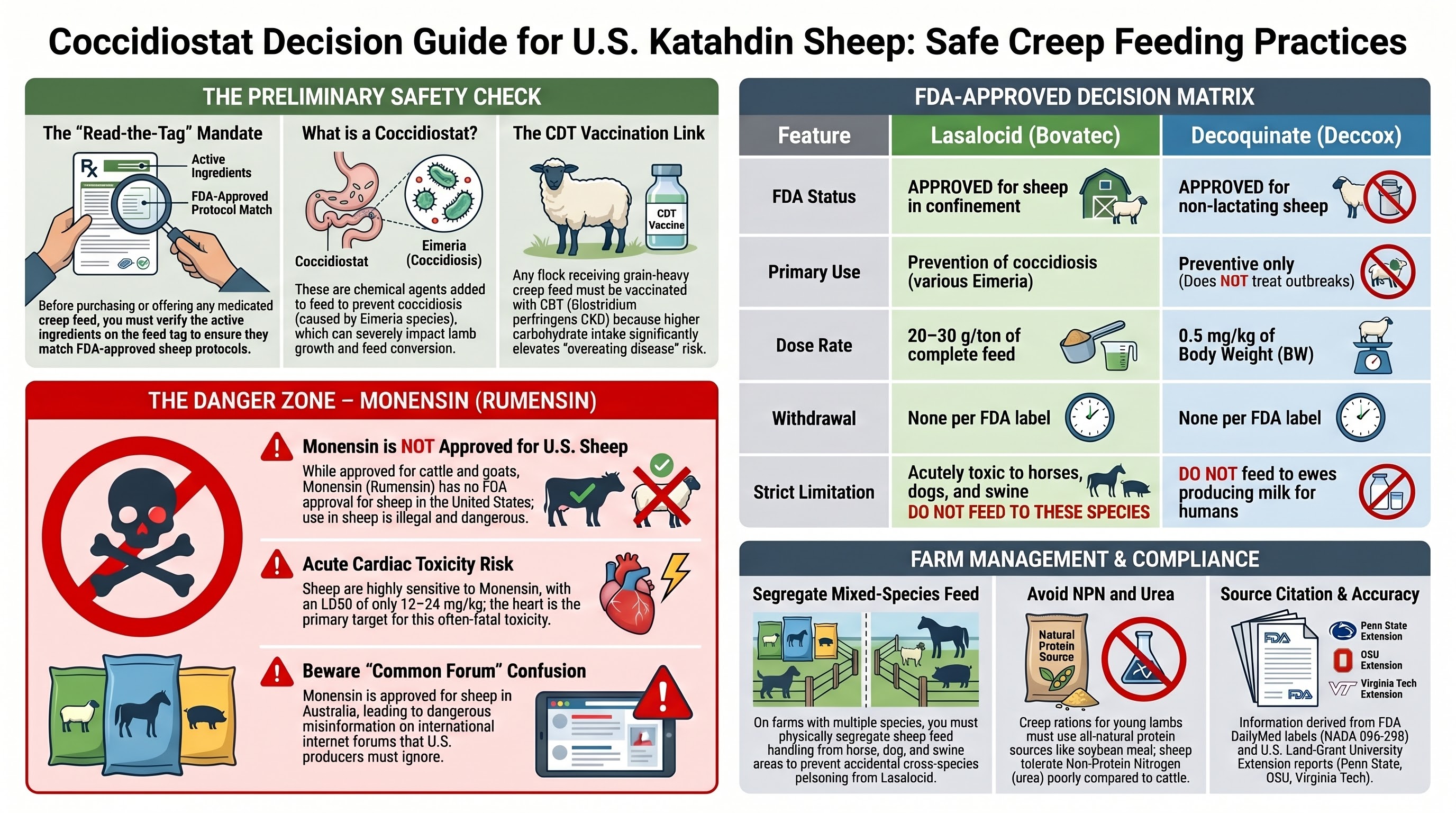
| Drug | FDA-approved for U.S. sheep | Dose | Sheep-specific notes |
|---|---|---|---|
| Lasalocid (Bovatec) | Yes, for confined sheep | 20 to 30 g per ton complete feed, 15 to 70 mg per head per day by body weight | Acutely toxic to horses, dogs, swine, and poultry. Segregate feed handling on mixed-species farms |
| Decoquinate (Deccox) | Yes, for non-lactating sheep | 0.5 mg per kg body weight, 1.67 to 3.34 kg per metric ton in feed, fed 28 days or longer | Do not feed to ewes producing milk for human consumption. Preventive only - does not treat clinical outbreaks |
| Monensin (Rumensin) | NO - not approved for U.S. sheep | n/a | Approved for cattle, goats, and poultry only. Sheep LD50 is 12 to 24 mg per kg, against 50 to 80 mg per kg for cattle. The heart is the primary toxicity target. Monensin IS approved for sheep in Australia, which is the source of frequent forum confusion |
The monensin issue is worth dwelling on. Online sheep forums regularly recommend monensin for U.S. coccidiostat use because the Australian label is broader. The Australian label does not apply in the U.S. The FDA Center for Veterinary Medicine page on the generic monensin approval explicitly flags toxicity for non-target species and reminds users that the U.S. label is cattle and goats only. Reading every feed tag at delivery is the operational control. A bag of medicated cattle creep that ends up in the sheep barn because someone grabbed the wrong pallet is a flock-level event.
Lasalocid is the workhorse for U.S. confined-sheep creep. It is approved against the Eimeria species that matter for sheep coccidiosis and it has no withdrawal on the label. The cross-species toxicity matters because farms with horses, dogs, swine, or poultry need physical separation of the medicated feed and the storage. A single chicken eating spilled lasalocid sheep creep is a dead chicken.
Decoquinate is the alternative. The label restriction on lactating dairy ewes is the constraint that matters for most operations. The other operationally important point is that decoquinate is preventive, not therapeutic. Once a lamb is showing bloody diarrhea and dehydration, decoquinate is the wrong tool - the lamb needs sulfa or amprolium under veterinary direction.
The mandatory companion to any creep-fed flock is CDT vaccination. Higher carbohydrate intake elevates Clostridium perfringens C and D risk in lambs, which means enterotoxemia. The schedule depends on dam history. Dams vaccinated with CDT four to six weeks pre-lambing produce lambs that get their first CDT at six to eight weeks with a booster at 10 to 12 weeks. Lambs from unvaccinated dams need a first dose at week one with a booster four weeks later. There is no creep program that should run without the corresponding CDT schedule.
Feeder Geometry
Creep feeders work by exclusion. The geometry has to admit lambs and exclude ewes. The Penn State Extension specs are practical:
| Dimension | Spec |
|---|---|
| Panel opening width | 6 to 9 inches |
| Panel opening height | ~36 inches |
| Gate height (overall) | 40 to 45 inches |
| Premier 1 adjustable gate | 18 to 28 inches in 1 to 2 inch increments |
| When to widen or wean | If openings must exceed ~7 inches to admit lambs, the lambs are large enough to wean |
SDSU Extension publishes a slightly different spec at 8 to 10 inches for lambs under 30 pounds. Either spec works. The Premier 1 adjustable gate is the most common piece of off-the-shelf hardware on small flocks because the openings can be tightened as the lambs grow without rebuilding the panel.
Floor space and bunk space are sized to the lamb count, not the ewe count. For a 20-ewe Katahdin operation lambing at roughly 1.6 to 1.8 lambs per ewe, plan for 30 to 35 lambs in the creep:
- Creep floor area: 1.5 to 2.0 sq ft per lamb, which puts a 30-lamb pen at 45 to 60 sq ft.
- Bunk frontage: roughly 2 inches per head, which puts a 30-lamb feeder at 60 inches (5 feet) of bunk.
- Siting: near ewe water and loafing so lambs find it on their own, weather-protected so the feed does not cake, and elevated or designed so lambs cannot stand in the feed and contaminate it with manure.
The creep feeder lives or dies on whether lambs find it early. A creep located on the far end of the barn from where ewes loaf is a creep that is going to be empty for the first three weeks while you wait for lambs to discover it. Site it where the ewes already are and where the lambs follow.
The Economics Are Asymmetric
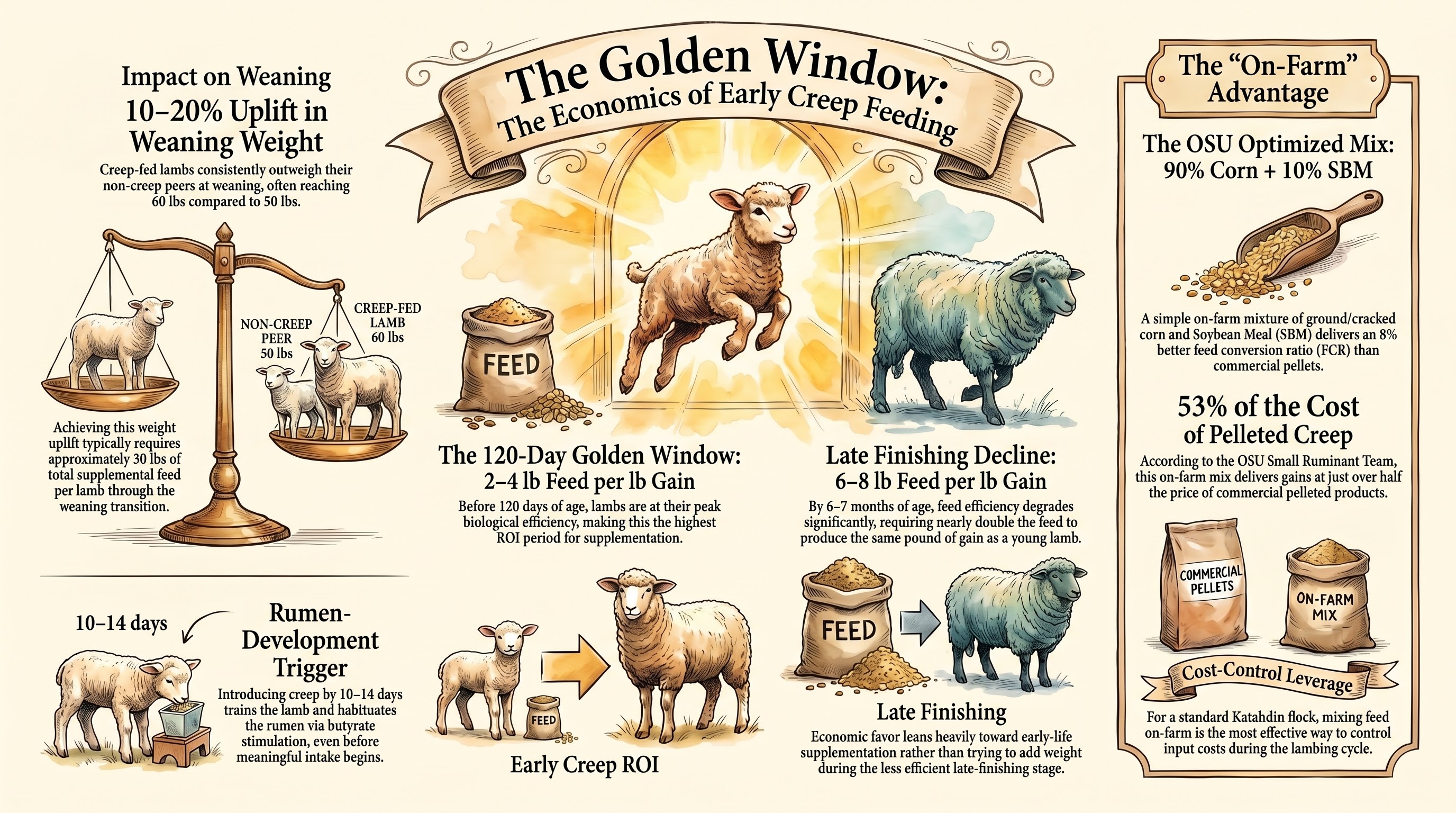
The Ohio State Small Ruminant Team published a comparison of pelleted commercial creep against an on-farm 90 percent corn plus 10 percent soybean meal mix at roughly 12.5 percent crude protein. The on-farm mix delivered 8 percent better feed conversion than the pelleted commercial creep, at 53 percent of the cost per pound of gain. For a small flock with the time and the feed mill access to mix on farm, that is the largest cost-control lever after ewe body condition score management.
The weaning-weight uplift from creep is reported across extension publications at 10 to 20 percent. A non-creep-fed Katahdin lamb might wean at 50 pounds; a creep-fed lamb at 60. The uplift consumes about 30 pounds of supplemental feed per lamb across the run. Twins and triplets benefit more than singles because ewe milk capacity caps the pounds the lamb can pull off the ewe and creep fills in the gap. Forage quality matters in the same direction - on poor forage the creep substitutes for the missing pasture nutrition, and on good forage the gap is smaller.
The Katahdin-specific tradeoff is that Katahdin lambs are reportedly the only U.S. livestock species capable of producing a USDA Choice carcass on forage alone. On a good legume-grass pasture - Tifton-9 bahia oversown with rye, clover, and Daikon radish in the southeast, or perennial cool-season pastures in the mid-Atlantic - maternal milk plus forage can drive 0.4 to 0.6 lb per day average daily gain without a single pound of grain. The creep decision is therefore conditional. If your ewes produce strong milk, your forage is high quality, and your marketing window favors the slightly later finish, creep may not pay. If any of those three is weak, creep pays sharply. The flock decision is rarely "creep yes or no" forever; it is "creep this season because the forage is short and twin-lamb count is high."
The NSIP nuance behind this is that maternal-milk EBV matters more in pasture-only systems where the lamb cannot compensate for weak milk via concentrate intake. Selecting for milk through maternal weaning weight EBV is the long-term answer to lower creep dependence.
Ewe Nutrition Is Half the Lamb Story
Lamb average daily gain through six to eight weeks is dominated by ewe milk yield, which is dominated by ewe body condition and energy and protein intake. Creep cannot substitute for ewe nutrition before week three. The ewe ration is therefore the first lever and the creep ration is the second.
The 2007 NRC for Small Ruminants segments the ewe production cycle into maintenance, breeding, early gestation, late gestation, early lactation (weeks 1 to 6), mid-lactation (weeks 7 to 12), and late lactation (after week 12), with separate tables for singles, twins, and triplets. The full tables are paywalled in the National Academies publication. The Iowa State and Langston ration-balancer tools paraphrase the NRC into usable on-farm calculators.
Late gestation is the highest-leverage window because 80 percent of fetal growth happens in the last four to six weeks. Energy step-up versus maintenance:
| Litter | Energy step-up | Target ration |
|---|---|---|
| Single | +50 percent | 59 to 65 percent TDN, 10.5 to 11.5 percent CP, 3.5 to 4.5 lb DM per day |
| Twin | +75 percent (Penn State) or +180 percent (PMC review) | Same with upper-end DMI |
| Triplet | +240 percent (PMC review) | Highest plane, pregnancy toxemia risk is real |
The Penn State and the PMC pregnancy-toxemia review disagree on the exact step-up for twin- and triplet-bearing ewes. The difference is the maintenance baseline each is computed against. The operational synthesis is that twin- and triplet-bearing ewes need to be fed to appetite on 60-percent-plus TDN forage with a concentrate top-up, body condition score should be checked weekly in the last four weeks, and the failure mode is pregnancy toxemia. A ewe that goes off feed in the last two weeks of gestation with a twin or triplet load is an emergency.
Lactation is where the milk shows up. Early lactation (weeks 1 to 6) targets roughly 70 percent TDN and 14 percent CP. A 175-pound ewe nursing twins is targeting 6.6 lb of dry matter intake delivering 71 percent TDN and 14.8 percent CP. Mid- and late lactation drop per the NRC 2007 tables.
The single most underused operational lever in small-flock ewe nutrition is splitting ewes into single-bearing, twin-bearing, and triplet-bearing feeding groups. Feeding all ewes together overfeeds the singles (with conception consequences in the next breeding cycle) and underfeeds the triplets (with pregnancy toxemia risk). On a 20-ewe flock with a scanning ultrasound at 45 to 90 days of gestation, the three-group split is straightforward to implement. Without scanning, the proxy is body condition score and history - a ewe that triplets routinely is a triplet candidate again, and the feeding group should reflect that.
The body condition score targets through the cycle are well-established:
| Phase | BCS target |
|---|---|
| Operating envelope | 2.5 to 4.0 |
| 45 to 60 days pre-breeding (start of flush) | 2.5 to 3.0 |
| Ram turnout, single targeting | 3.0 to 3.5 |
| Ram turnout, twin targeting | 3.5 to 4.0 |
| Lambing, twin-bearing | 3.5 to 4.0 |
The caveat is that BCS above 4.0 reduces conception. Over-conditioning is a real risk on flocks with abundant pasture and can blunt the conception rate the producer is trying to optimize.
A separate finding worth flagging because it travels under the radar: higher rumen-undegradable (bypass) protein in late gestation - distillers grains or soy-pass - measurably blunts the periparturient fecal egg count spike. The mechanism is that the dam's immune competence is partly protein-limited around lambing, and adequate bypass protein supports the immune response that would otherwise be suppressed by the metabolic load of late gestation and early lactation. This is a nutritional lever for parasite control, complementary to refugia management and FAMACHA-driven targeted treatment, and it does not show up in most basic ration discussions.
The Replacement Ewe Lamb Problem
The most counter-intuitive piece of the creep program is what to do with the replacement candidates. Heavy creep feeding from two to four months of age deposits fat in the developing mammary gland. That fat is permanent and it permanently impairs future milk yield. The fastest-growing creep-fed ewe lamb in the spring crop is, paradoxically, often the worst replacement candidate at retention time.
The published target is 0.25 to 0.50 lb per day average daily gain in the two-to-four-month window, with 0.33 lb per day as the operational midpoint. That is roughly half of the maximal ADG a creep-fed market lamb will hit in the same window. The implication is operational: at the NSIP weaning weigh-day around 60 days, replacement candidates need to be flagged and shifted onto a forage-dominant, lower-supplementation plane. The market lambs continue full creep. The two groups merge again later when the replacement candidates return to a moderate growth plane to hit roughly 65 percent of mature body weight by joining.
This is a two-group feeding problem on top of the ewe litter-size split. On a 20-ewe flock that is three or four feeding groups in late spring: market lambs on full creep, replacement-candidate ewe lambs on restricted plane, dry yearlings on maintenance, and the breeding ewes still in lactation. The labor cost is real and the equipment cost is real, and most small-flock operations underbuild their pen layout for the season's peak group count.
Risk Summary
| Risk | Trigger | Mitigation |
|---|---|---|
| Urinary calculi (ram and wether lambs) | High-phosphorus, low-calcium grain creep | Calcium to phosphorus ratio of 2:1 or higher via limestone or alfalfa, optional 0.5 percent ammonium chloride |
| Copper toxicity (chronic) | Cattle, horse, or poultry mineral fed to sheep, low molybdenum | Sheep-specific premix only, 15 ppm Cu maximum, verify Mo of 1 ppm or higher |
| White muscle disease (selenium and vitamin E deficiency) | Mid-Atlantic Se-marginal soils, rapid lamb growth | Selenium 0.10 to 0.30 ppm in dam late-gestation ration, BoSe injection as fallback under veterinary direction |
| Enterotoxemia (Cl. perfringens C and D) | Creep raises rumen carbohydrate load | Dam CDT 4 to 6 weeks pre-lambing, lamb CDT 6 to 8 weeks plus booster 10 to 12 weeks |
| Ionophore toxicity (acute death) | Feeding cattle or goat product containing monensin to sheep | Read every tag, monensin is not FDA-approved for U.S. sheep |
| Pregnancy toxemia | Negative energy balance late gestation, especially twin or triplet | Step up energy, feed to appetite on 60-percent-plus TDN forage in last 4 to 6 weeks, BCS monitoring |
| Replacement ewe milk yield loss | Excess creep on selection candidates 2 to 4 months | Target 0.33 lb per day ADG, separate from market lambs at NSIP weigh-day |
| Lasalocid cross-species poisoning | Mixed-species farm feed handling | Segregate sheep feed from horse, dog, swine, and poultry feed |
| NPN tolerance failure | Urea in young-lamb creep | All-natural protein only, soybean meal or cottonseed meal |
A Pause Point
The creep feeder is the cheapest piece of equipment in the lambing barn. The mineral premix is the cheapest medication. Both are easy to get wrong, and the failure modes for either are flock-level events that show up at weaning weights, in lamb crop quality, and in the long-term productivity of the replacement ewe lambs that you thought you were doing a favor by feeding hard.
The structure that holds the program together is small. Read every feed tag and confirm the coccidiostat is lasalocid or decoquinate, never monensin. Buy sheep-specific mineral and refuse the temptation to standardize on a mixed-species product. Put creep in front of lambs by 10 to 14 days and accept that the first month is rumen training rather than weight gain. Split the ewes into litter-size feeding groups in late gestation and hold them there through early lactation. Pull the replacement candidates off full creep at the NSIP weaning weigh-day and run them at 0.33 lb per day ADG instead. None of those decisions cost much. All of them compound.
The lambing series picks up the rest of the first-year arc. Part 5 covers vaccination and parasite control in the same window where the coccidiostat in the creep is doing its work. Part 6 covers the NSIP weighing milestones that close the loop on whether the creep program produced the genetic and growth outcomes you intended.
This article synthesizes research from Penn State Extension, Virginia Cooperative Extension, the Ohio State Small Ruminant Team, SDSU Extension, the Maryland Small Ruminant Page, University of Maryland Extension, Michigan State University Extension, Purdue Extension, the FDA Center for Veterinary Medicine, the Merck Veterinary Manual, the National Research Council Nutrient Requirements of Small Ruminants (2007), peer-reviewed sources on pregnancy toxemia, the Eastern Alliance for Production Katahdins, Katahdin Hair Sheep International, Premier 1 Supplies, and Purina. It is intended as educational reference - always consult your veterinarian for medical decisions specific to your flock.